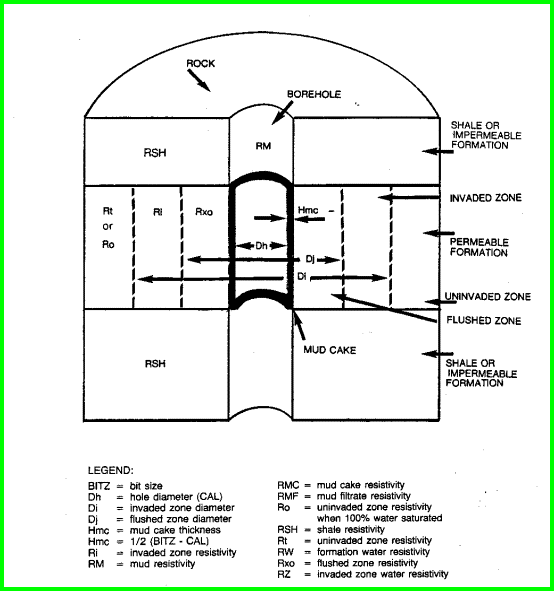
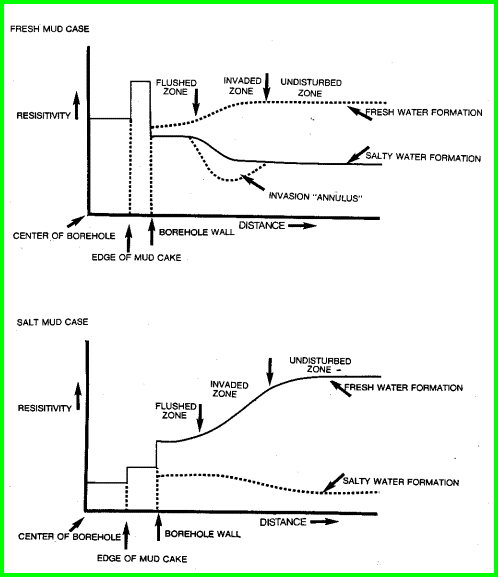
Invasion is a process whereby drilling mud fluid is forced into the rock due to differential pressure. The drilling mud is made up of solid particles and ions dissolved in water. This water displaces the native formation water to some degree, and mixes with formation water that is not displaced. The distance to which some displacement and/or mixing occurs is called the invasion diameter, and the zone so disturbed is termed the invaded zone. The zone nearest the borehole, or flushed zone, is the portion of rock where the maximum amount of displacement and mixing has occurred. The balance of the invaded zone is sometimes named the transition zone, where the transition between maximum flushing and no invasion occurs. This is confusing, as there may be a vertical transition zone between oil and free water in a reservoir, so we avoid the use of transition zone in the invasion profile description. The invasion process leaves behind the solid particles of the mud, which collect on the borehole wall. The resulting material is called mud cake, and may be 3 to 4 inches thick or very thin and difficult to detect. The mud cake thickness by definition is one half the difference between the bit size and the borehole diameter. If the hole is enlarged by erosion beyond the bit size during drilling, the mud cake thickness may be impossible to determine. Mud cake is the sealing agent which slows down invasion. As a result, high permeability zones which allow quick buildup of mud cake, invade the least and low permeability zones invade the most or deepest. Non-permeable zones are not invaded. This sounds counter-intuitive, but that is what happens with a good quality drilling mud. Poor quality or native mud may not form a mud cake, and invasion will proceed in proportion to the permeability.
The
traditional abbreviations and definitions listed below describe conditions
found within the near-wellbore environment: Since the depth of investigation of logging tools varies, knowledge of the invasion profile is necessary in making assumptions about log analysis methods or parameters. This can sometimes be inferred from the relationship between shallow, medium, and deep investigation resistivity logs recorded in permeable water zones. Most porosity-indicating logs read the flushed zone and part of the invaded zone, as do the gamma ray, SP, and shallow resistivity logs. Micrologs read mostly in the flushed zone. Residual hydrocarbons in the flushed and invaded zones, especially gas, will influence all shallow investigation logs.
Resistivity
logs that measure different depths into the rock can be used to
estimate the invasion profile. Results are used to judge the reliability
of resistivity data, and to correct the log readings for the effects
of invasion. |
|
|||||
|
Page Views ---- Since 01 Jan 2015
Copyright 2023 by Accessible Petrophysics Ltd. CPH Logo, "CPH", "CPH Gold Member", "CPH Platinum Member", "Crain's Rules", "Meta/Log", "Computer-Ready-Math", "Petro/Fusion Scripts" are Trademarks of the Author |
||||||


|
||
| Site Navigation | PETROPHYSICS COURSE DRILLING FLUID INVASION PROFILES | Quick Links |
 HOW DRILLING FLUID INVASION AFFECTS YOUR LOGS