|
Although
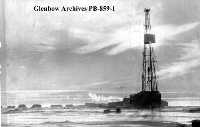
he may not have been the first to do so, Dr.
George Dawson of the Geological Survey of Canada, collected information
on the wells drilled by the Canadian Pacific Railway as they
moved West in the early 1880's. He presented a paper
to the Royal Society of Canada in May, 1886, called
"On Certain Borings in Manitoba and the Northwest Territory".
The paper contained detailed sample descriptions of the wells
- possibly the first "well logs" in Western Canada.
Some these wells flowed gas; the first gas wells in Canada were at
Langevin Siding, near Medicine Hat. A quote from the official Schlumberger history tells the story: “In another part of the country, a young engineer named Bill Gillingham was attempting to raise some interest in electric logging in the Bradford, Pennsylvania area. The response was not immediately tremendous. A trainee under Gillingham, R.R. Rieke, was told to head west by northwest, to Mt. Pleasant, Michigan, embarking on one of the strangest Schlumberger journeys you’ve heard of.”
"You see, they ended up in Canada, not looking for oil, but for gold. The preliminary work had been conducted by Andre Allegret and, as a result of surface exploration, a contract had been let. “When we arrived,” Rieke said, “trouble was afoot. They had found gold alright, but not where the survey had said. When they drilled there - nothing. We left rather quickly.” Schlumberger didn't return to log in Canada until 1946.
Early
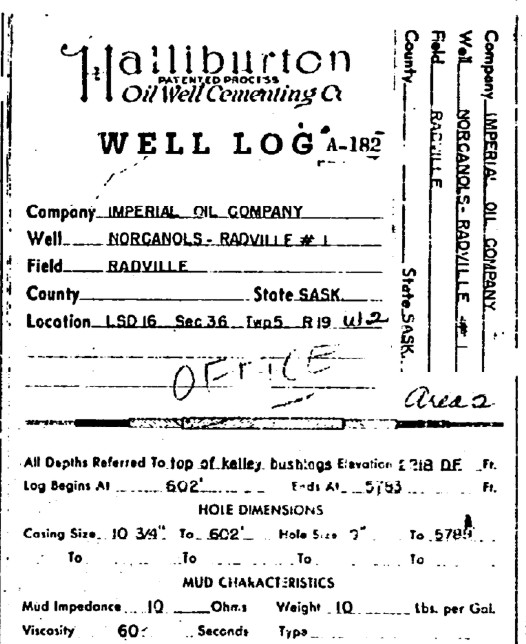
Halliburton ES log 11 Nov 1942, Imperial The approximate dates of first availability of modern logging methods, as recalled by Gerry Obermeyer, a manager of operations for Halliburton, were Focused Resistivity 1952, Radioactive 1954, Induction 1954, and Acoustic 1958. A shift in the development of Canadian operations also occurred in 1957 when the parent company purchased WELEX Incorporated. A combined WELEX-Halliburton Electrical Well Section operated in Canada as a separate company for some time. The perforating service, which had also been introduced to Canada by Halliburton in 1940, was expanded. Later, that group was absorbed as an operating division of Halliburton Services Ltd.
Early Schlumberger Truck c. 1949
One of the older units in Canada about that time required that the crew jack up the rear end and install a chain from the rear axle to the winch drive. Services offered were ES, six-shot sidewall core guns and bullet perforating. By 1949, there were offices in Calgary and Edmonton, and Neil Collins was at the helm in booming Redwater. Barry McVicar had joined the forces as well. By 1951, tools available were ES, gamma ray, dipmeter, directional, cores, microlog, laterolog, limestone device, temperature, perforating and caliper. The year 1951 also saw the introduction of revolutionary armoured steel cable to replace the 1 inch diameter fabric-covered line known as the “ragline”.
Ten years later (1961) saw the first logs to be run in Canada’s Arctic Islands at Winter Harbour on Melville Island. Since that epic event, operations have taken place in all the frontier areas from the misty Queen Charlottes to Hudson’s Bay, the High Arctic Islands, the East Coast, and the Beaufort Sea. Lane-Wells established their first office in Edmonton on the Cooking Lake Trail in 1947, offering the usual GR log, perforating services, and later neutron and ES logs. They quickly opened stations in Stettler, Virden, Swift Current, Estevan, Drayton Valley, Red Deer, Swan Hills, and Fort St. John, the hot spots of the time. The early managers were Bill Ludwig, Lee Lobdell and Glenn Robinson. Perforating Guns of Canada Limited opened their first office in Edmonton on Calgary Trail in 1949. Walt Minor and Bill McKay were the people in charge. In the early 1950’s radiation logging for cased and open hole was one of the primary services available, out of the usual towns such as Lloydminster, Kindersley, Stettler, Estevan, and Drayton Valley. In 1965, the name was changed to Pan Geo Atlas Canada Limited and open-hole logging services were introduced in the following year. In July of 1968, PGAC and Lane-Wells merged into one larger operation under the auspices of Dresser Atlas Inc. The combined companies offered a full line of services from various Canadian locations thereafter. Still later, Baker Hughes took over the entire Dresser complex, with the logging division becoming Baker-Atlas. McCullough Wireline Services were around in the early 50s and offered services mainly in the cased-hole field. Mart Kernahan, one of the early managers, became better known for his contribution to the early days of computed log analysis at Computrex Computer Services Limited in the early 60s. Mart recognized the potential of the scintillometer, developed at the University of Manitoba, and offered it in place of the less efficient Geiger-Muller GR counter; now nearly all GR logs are run with scintillation counters. The late 50s and most of the 1960s saw a number of independent wireline operators appear on the scene. This trend continued, with one of the notable successes being the acquisition of an interest in Wireline Electronics (1976) Limited by Perfco Services Limited in 1976. Later in the year, the management of Perfco and Wireline joined with Gearhart-Owen Inc. of Fort Worth, Texas, to offer the Gearhart direct digital logging system in Canada for open-hole logging under the name of Computalog Services Limited. Perfco, Wireline and Computalog operated somewhat independently until 1979 when they were amalgamated to form Computalog-Gearhart Limited. A number of further corporate maneuvers saw Gearhart go to Halliburton, Computalog go independent, finally becoming part of Precision Drilling and renamed Precision Wireline in 2003, followed by another acquisition to become part of the Weatherford group of services in 2005. Precision had acquired Reeves Wireline at the same time as Computalog; Reeves was previously known as BPB Wireline, originally the well logging arm of British Plaster Board, one of the largest gypsum mining companies in the world. BPB arrive in Canada in the early 1980's.
Founded in Canada by Keith Banks in 1967, Roke Oil Enterprises
was initially a mining services company. Roke provided
specialized measurements for grading uranium, copper, and coal
prospects. In the early 1970s, Roke developed the Quad Neutron
Log with a novel, and patented, concept that could assess both
porosity and hydrocarbon saturation without the need for a
resistivity log. Keith retired in 2008 and worldwide logging
operations continue under new owners as Roke Technologies Ltd.
Wellsite Log Interpretation circa 1962
Pioneers of the CWLS were Al Brown, Ed Burge, Nick Ediger, Barry McVicar and Gerry Shaw. Barry provided the beer and Gerry the sandwiches at the organizational meeting in the 400 Club card room. At least we know what their priorities were. Other important names involved in the early years of the CWLS were A.G.T. Weaver, A.A. Perebinossof, Leo Vladicka, Ted Connolly, Trev Cutmore, Don Tough, Bob Labelle, Percy Cole, Doug Morrison, and Mart Kernahan. Some important names may have been left from this list, and I hope that response from readers will generate a more complete history of the early years of the society. The society was even brave enough to open a chapter in Regina, which was active between 1957 and 1961. Don Tough was one of the prime movers in this venture.
Although lunch and evening meetings were held
for a number of years, there is no formal printed record of the
topics or papers presented until 1968 with the appearance of
CWLS Journal, Volume 1 and almost simultaneously the
Transactions of the 2nd Formation Evaluation Symposium. Symposia
had been held roughly every second year. The Journal ceased
publication with Volume 10 in 1977, but was revitalized in 1982
and it continued until 1992. This was followed by CWLS InSite, a
technical journal and newsletter.
CWLS members developed the Log ASCII Standard
(LAS) digital data file format for interchange of well log data.
This is now the de-facto world standard for log data and the Society
gets no income and damn little acknowledgement for this innovative
contribution to our profession.
|
|
||
|
Page Views ---- Since 01 Jan 2015
Copyright 2023 by Accessible Petrophysics Ltd. CPH Logo, "CPH", "CPH Gold Member", "CPH Platinum Member", "Crain's Rules", "Meta/Log", "Computer-Ready-Math", "Petro/Fusion Scripts" are Trademarks of the Author |
|||


|
||
| Site Navigation | HISTORY WELL LOGGING IN CANADA | Quick Links |
 MAJORS,
MINORS, MERGERS, and MORE
MAJORS,
MINORS, MERGERS, and MORE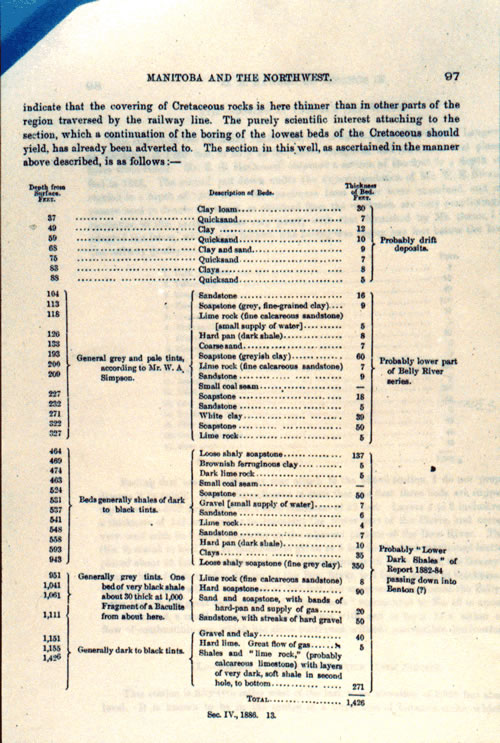
 Two
years, later, “electric logs” were introduced to the
Canadian oil patch in 1939 by the forerunner of today’s
Halliburton Services Ltd.
Two
years, later, “electric logs” were introduced to the
Canadian oil patch in 1939 by the forerunner of today’s
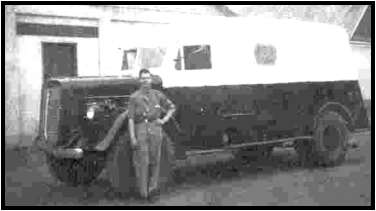
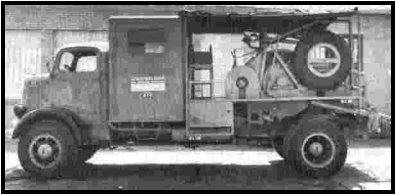
Halliburton Services Ltd. Early Halliburton Logging Truck c. 1946
 The logger of those days had to be versatile because he was often
called upon to operate cementing and acidizing equipment, or run
drill-stem tests, in addition to the standard electrical survey
(ES). With increased demands after the Leduc discovery in 1947,
more modern survey equipment was added. Also, the “FM”
(frequency modulated) system of transmitting sub-surface data
via a single conductor cable was adopted by Halliburton. This
technique remained a unique feature of the Halliburton-Welex wireline
equipment for many years.
The logger of those days had to be versatile because he was often
called upon to operate cementing and acidizing equipment, or run
drill-stem tests, in addition to the standard electrical survey
(ES). With increased demands after the Leduc discovery in 1947,
more modern survey equipment was added. Also, the “FM”
(frequency modulated) system of transmitting sub-surface data
via a single conductor cable was adopted by Halliburton. This
technique remained a unique feature of the Halliburton-Welex wireline
equipment for many years.
 Schlumberger
arrived permanently in Canada in 1946 by opening a location at
Lloydminster, manned by such notables as Ed Burge, Hugh Gough,
and Arne Thorson. Truck numbers were in the 200 series.
Schlumberger
arrived permanently in Canada in 1946 by opening a location at
Lloydminster, manned by such notables as Ed Burge, Hugh Gough,
and Arne Thorson. Truck numbers were in the 200 series.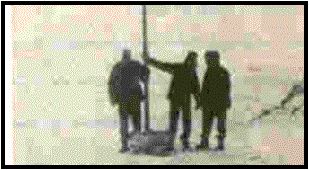 A
job report of that year mentions a trip to a well near Fort Vermillion
that commenced the 26th of April and ended June 29th, with most
of the intervening time spent attempting to get to the well by
building bridges and barges, waiting for ferries, and sinking
into mud.
A
job report of that year mentions a trip to a well near Fort Vermillion
that commenced the 26th of April and ended June 29th, with most
of the intervening time spent attempting to get to the well by
building bridges and barges, waiting for ferries, and sinking
into mud. 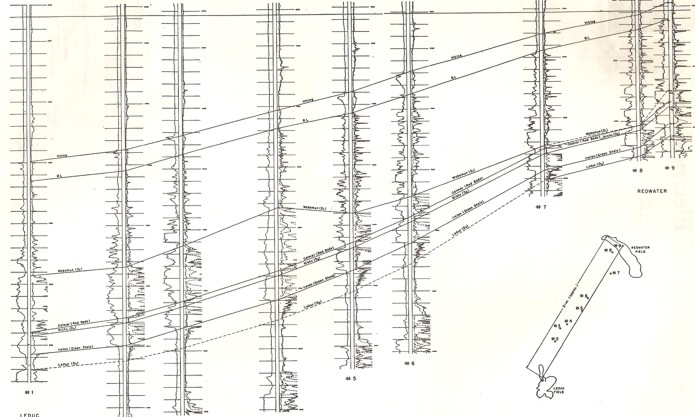
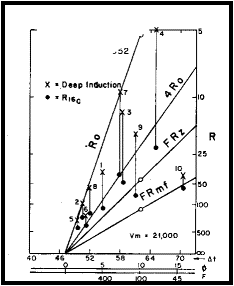 By
the early 1960's, the induction log supplanted the ES and the sonic
log was in use as a porosity indicating log. Micrologs and
laterologs were still common. Log analysis became more quantitative,
but this was 1960 BC (Before Calculators) so we used charts and
nomographs to perform the math. A few brave engineers used a slide
rule to solve for water saturation from the Archie equation. An
analysis was required on the main target zone, and was attached to
the field print of the logs, but they were stripped off before the
final prints were delivered to the client. Maybe there was a
quality control issue?
By
the early 1960's, the induction log supplanted the ES and the sonic
log was in use as a porosity indicating log. Micrologs and
laterologs were still common. Log analysis became more quantitative,
but this was 1960 BC (Before Calculators) so we used charts and
nomographs to perform the math. A few brave engineers used a slide
rule to solve for water saturation from the Archie equation. An
analysis was required on the main target zone, and was attached to
the field print of the logs, but they were stripped off before the
final prints were delivered to the client. Maybe there was a
quality control issue? The
Canadian Well Logging Society was formed in 1954 after a group
of people in the major oil companies and service companies in
Canada perceived the need for the exchange of ideas and technical
information. This was the first technical society in the world
to exclusively promote the science of petrophysics.
The
Canadian Well Logging Society was formed in 1954 after a group
of people in the major oil companies and service companies in
Canada perceived the need for the exchange of ideas and technical
information. This was the first technical society in the world
to exclusively promote the science of petrophysics. 