|
Later, the nature of the mineral and its relation to the surrounding oil shale was described correctly. Abraham Gesner used Albertite in his early experiments to distill liquid fuel from coal and solid bitumen. He is credited with the invention of kerosene in 1846, and built a significant commercial distillery to provide lighting oil to replace whale oil in eastern Canada and USA. In the 1880's, shale oil was abandoned as a source of kerosene in favour of distillation from liquid petroleum.
Early
oil well at Petrolia, Ontario, Canada c. 1860's The contribution that Canadians made to the world's petroleum industry during the same period is even less appreciated. Men trained in the production, transportation, refining, and administration of this new resource, took their knowledge and skills to every corner of the world, opening many of the great oil fields that are still major suppliers of crude. They laboured on every continent in a hundred different countries. And the tradition continues to this day.
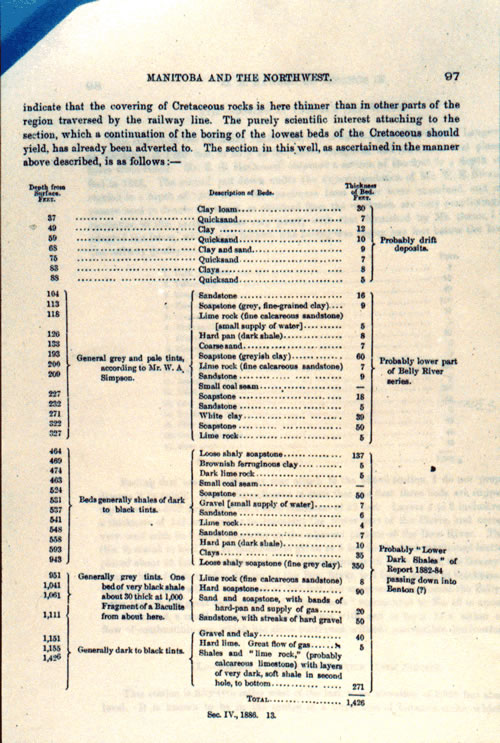
New Brunswick achieved commercial production at Stoney Creek in 1884, although it was pretty minor by early Ontario standards, and these wells continued in production until modern times. Quebec, Prince Edward Island, onshore Nova Scotia, and onshore Newfoundland never found commercial quantities of oil or gas. The first gas well in Alberta was drilled in 1883 at Alderson (then known as Langevin Siding), near Medicine Hat, by the Canadian Pacific Railway. They were, of course, looking for water. This well struck gas, caught fire, burned down the rig injuring one man who had to jump off, and was abandoned. A second well, the following year, again struck gas (it was only 8 feet away from the first one) and produced off-and-on for about 40 years. These, and similar wells, came to the notice of the Canadian government. Dr. George Dawson of the Geological Survey of Canada, collected information on the wells at Langevin Siding and others, and presented a paper to the Royal Society of Canada in May, 1886. The paper was called "On Certain Borings in Manitoba and the Northwest Territory". The paper contained detailed sample descriptions of the wells - possibly the first "well logs" in Western Canada.
By the early 1890s several more wells had been drilled in the Medicine Hat area, producing gas for homes and factories. Rudyard Kipling, on a visit in the early 1900’s, admitted that he liked Medicine Hat but "It has all hell for a basement!"
Dingman #1,
Turner Valley, Alberta, Canada, 1914
The
well was the precursor for the deeper zone discovery drilled ten
years later. Royalite #4 put Turner Valley on the oil and gas
map for real.
Vern Hunter,
and Leduc #1
blowout, Leduc, Alberta, Canad, 1947 Although minor shows were found much earlier, 1951 saw the first commercial oil discoveries in Manitoba and British Columbia, followed by Saskatchewan ln 1953. Over the next 20 years, Canada became self sufficient in oil and gas.
Shell drilled offshore British Columbia
that year, but found nothing. A few years later, the BC Government
placed a moratorium on further drilling that has not been lifted.
On the other frontiers, hydrocarbons were found offshore Nova Scotia (gas at Sable Island, 1967, oil at Cohasset, 1973), offshore Newfoundland (oil at Terra Nova, 1984), offshore in the Beaufort Sea and MacKenzie Delta (gas at Taglu, 1971, oil at Amauligak, 1978), onshore and offshore in the High Arctic Islands (gas at Drake Point, 1969 - oil at Bent Horn, 1974). It took between 20 and 30 years for some of these to come on-stream, and Arctic gas is still shut-in.
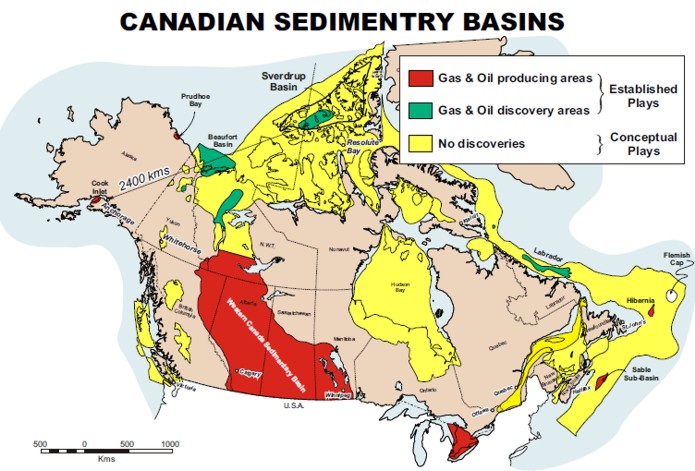
Canada's steady increase in production contrasts markedly with production declines in nearly every other oil-producing country. The majority of Canadian production is exported to the United States by pipeline. Canada is the largest single supplier of US oil needs, a fact not well appreciated by US citizens or the rest of the world. Aside from the tar sands, another significant reason for increased production is that small independent oil companies, operating under a favourable free-enterprise tax system and rule of law, are content to produce from thin, low productivity, low quality reservoirs. The risk of political upheaval or confiscation is very low.
Policies, politics, and egos (not economics) make production from
poor quality reservoirs difficult in most other regimes, except in
the continental US and Western Europe on-shore. There is no magic
bullet to cure the world's addiction to oil, so the exploitation of
lower quality reservoirs will have to become "standard operating
practice" very soon in the rest of the world. |
|
||
|
Page Views ---- Since 01 Jan 2015
Copyright 2023 by Accessible Petrophysics Ltd. CPH Logo, "CPH", "CPH Gold Member", "CPH Platinum Member", "Crain's Rules", "Meta/Log", "Computer-Ready-Math", "Petro/Fusion Scripts" are Trademarks of the Author |
|||


|
||
| Site Navigation | HISTORY OIL AND GAS IN CANADA | Quick Links |
 CANADIAN
OIL and GAS - BIGGER THAN YOU THINK
CANADIAN
OIL and GAS - BIGGER THAN YOU THINK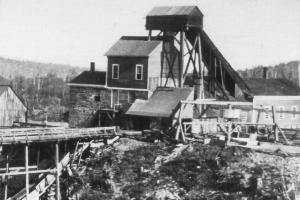 Canada
produced some shale oil from deposits in New Brunswick in the
mid-1800's. The mineral was called
Albertite and was originally believed to be a form of coal.
Canada
produced some shale oil from deposits in New Brunswick in the
mid-1800's. The mineral was called
Albertite and was originally believed to be a form of coal.  Albert Mine, near Moncton, New Brunswick,
c. 1850's
Albert Mine, near Moncton, New Brunswick,
c. 1850's The
subsequent development of Canada's first petroleum complex at
Petrolia in Ontario is a little known part of the industrial saga of the
oil industry. Canada's chemical valley in Sarnia traces its ancestry
directly to this area. During the period 1861 to 1897, nearly
the entire requirement of Canada for crude, lubricants, waxes,
kerosene, gasoline, and a widening range of chemicals for food,
medicine, and industry was produced here. From 1863 to 1870, Canada
was a major exporter of crude and refined products to the United
States and Europe.
The
subsequent development of Canada's first petroleum complex at
Petrolia in Ontario is a little known part of the industrial saga of the
oil industry. Canada's chemical valley in Sarnia traces its ancestry
directly to this area. During the period 1861 to 1897, nearly
the entire requirement of Canada for crude, lubricants, waxes,
kerosene, gasoline, and a widening range of chemicals for food,
medicine, and industry was produced here. From 1863 to 1870, Canada
was a major exporter of crude and refined products to the United
States and Europe.
 By
1908, development of the Bow Island gas field led to the first
pipelines to deliver natural gas to Alberta communities. Construction
of a 16-inch pipeline from southwest of Medicine Hat to Calgary
began in April 1912 and was completed in only 86 days. A second
leg reached Lethbridge in July 1908. This was spearheaded
by Eugene Coste, Canada's first natural gas engineer. He had discovered
the first commercial gas well in Essex County Ontario in 1888.
By
1908, development of the Bow Island gas field led to the first
pipelines to deliver natural gas to Alberta communities. Construction
of a 16-inch pipeline from southwest of Medicine Hat to Calgary
began in April 1912 and was completed in only 86 days. A second
leg reached Lethbridge in July 1908. This was spearheaded
by Eugene Coste, Canada's first natural gas engineer. He had discovered
the first commercial gas well in Essex County Ontario in 1888.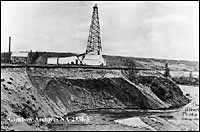 The
Alberta oil boom didn't begin until 1914 with the drilling of
Dingman #1 near Turner Valley. A replica of the drilling rig lives
at Heritage Park in Calgary. This wet gas success started a stock
market flurry that died less than a year later with the loss of
most of the investors' money.
The
Alberta oil boom didn't begin until 1914 with the drilling of
Dingman #1 near Turner Valley. A replica of the drilling rig lives
at Heritage Park in Calgary. This wet gas success started a stock
market flurry that died less than a year later with the loss of
most of the investors' money. In
1919, Imperial Oil geologist Ted Link, a crew of six drillers
and an ox named "Nig" made a six-week, 1200 mile journey
northward by railway, river boat, and on foot to the site now
known as Norman Wells NWT, along the Mackenzie River. The ox helped
to build a log house and put the drilling rig in place before
being butchered to provide food for the winter. Drilling resumed
in the spring with the world's most northerly oil discovery coming
in August 1920.
In
1919, Imperial Oil geologist Ted Link, a crew of six drillers
and an ox named "Nig" made a six-week, 1200 mile journey
northward by railway, river boat, and on foot to the site now
known as Norman Wells NWT, along the Mackenzie River. The ox helped
to build a log house and put the drilling rig in place before
being butchered to provide food for the winter. Drilling resumed
in the spring with the world's most northerly oil discovery coming
in August 1920.
 Between
1920 and 1947, there were a dozen or so significant oil discoveries
in the Cretaceous of Alberta, but no "elephants", and
nothing very deep. Vern Hunter drilled Imperial Oil's Leduc #1
Devonian oil discovery in 1947, ending a long dry spell in the
Alberta search.
Between
1920 and 1947, there were a dozen or so significant oil discoveries
in the Cretaceous of Alberta, but no "elephants", and
nothing very deep. Vern Hunter drilled Imperial Oil's Leduc #1
Devonian oil discovery in 1947, ending a long dry spell in the
Alberta search.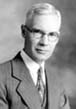 As
early as 1921, Dr. Karl Clark pioneered the extraction of oil
from tar sands by the hot water process. He built pilot plants
in 1930 at Clearwater, Alberta and in 1949 at Bitumont under the auspices
of the Alberta Research Council. Great Canadian Oil Sands Ltd
(later Suncor) began production of the Athabasca tar sands north
of Fort McMurray in 1967.
As
early as 1921, Dr. Karl Clark pioneered the extraction of oil
from tar sands by the hot water process. He built pilot plants
in 1930 at Clearwater, Alberta and in 1949 at Bitumont under the auspices
of the Alberta Research Council. Great Canadian Oil Sands Ltd
(later Suncor) began production of the Athabasca tar sands north
of Fort McMurray in 1967. 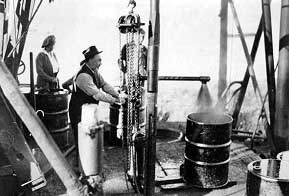
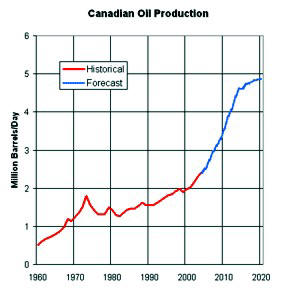 Canada's
conventional oil production peaked in 1974, but tar sands production
has replaced the decline. Current capacity in the
tar sands has brought Canadian production to more than 2 million
barrels per day, with a target of 5 million by the year 2020 (equal
to Iraq or Iran, and double Venezuela).
Canada's
conventional oil production peaked in 1974, but tar sands production
has replaced the decline. Current capacity in the
tar sands has brought Canadian production to more than 2 million
barrels per day, with a target of 5 million by the year 2020 (equal
to Iraq or Iran, and double Venezuela). 