A law can be proved, using the most primitive of physical or mathematical rules, whereas a theory cannot be proved. For example, the Law of Conservation of Energy can be proved by invoking more primitive physical laws. The Theory of Relativity cannot yet be proved, and alternate theories exist, although they are not widely held. A good theory explains all the known data, and may even predict as yet unobserved data, as the Theory of Relativity has done. A poor theory may still be widely believed, even if it fails to account for all observed facts. Some believers may discount the data that does not fit, assuming it is in error, or will predict that improvements to the theory will allow all data to fit. The controversy over Creation (now known as Intelligent Design) versus Evolution falls into this category. An empirical relationship differs from both a law and a theory. The empirical relationship is a mathematical "best fit" between two or more observed sets of data. Many individual data sets will not follow the empirical relationship well. For example, it is often true that a larger object weighs more than a smaller item, but there are many exceptions to that rule. These
relationships are often termed rules of thumb, and frequently
apply only in limited areas or under very restrictive circumstances.
Some relationships used in log analysis are actually laws, such
as those dealing with the summation of densities in mixtures.
Many, if not most, are empirical relationships, such as the Wyllie
time-average formula, or the Archie formation factor concept.
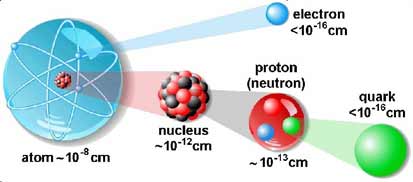
More recently, nuclear physicists have proposed the "Standard Model", showing that these so-called "basic particles" are actually made of even smaller elementary particles called, naturally enough, sub-atomic particles. There are two types of subatomic particles: elementary particles, which are not made of other particles, and composite particles. Some scientists have postulated that these elementary particles are composed of even more basic particles called preons (not to be confused with prions, a type of protein). No evidence exists to support this conjecture. The
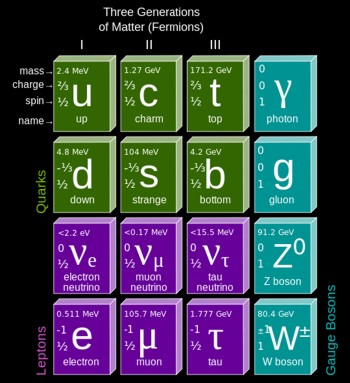
elementary particles of the Standard Model include:  Hadrons
are any
strongly interacting composite subatomic particle.
All hadrons are composed of quarks.
Hadrons
are any
strongly interacting composite subatomic particle.
All hadrons are composed of quarks.
 QUARKS
Abbrev Elec Charge Mass QUARKS
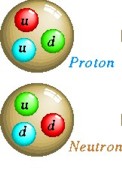
Abbrev Elec Charge Mass Up u +2/3 2 MeV Stable Down d -1/3 5 MeV Stable Two Up quarks and 1 Down quark make a Proton with net charge of +1. Two Down quarks and 1 Up quark make a Neutron with net charge of 0. Charm C +2/3 1.25 GeV Unstable Strange S - 1/3 95 MeV Unstable Top t +2/3 171 GeV Unstable Bottom b -1/3 4.2 GeV Unstable The unstable quarks make up short-lived particles, seen only in very high energy physics labs and cosmic rays.
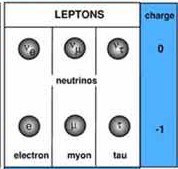 LEPTONS
Abbrev Elec Charge
Mass
LEPTONS
Abbrev Elec Charge
Mass Electron e -1 0.511 MeV Stable Muon u -1 105 MeV Unstable Tau T -1 1.78 GeV Unstable e . There are three Neutrinos corresponding to each of the three leptons. Neutrinos have no charge and rarely interact with ordinary matter.
Fermions
comprise all particles with spin of 1/2. These are the 6
quarks, 6 anti-quarks, 6 leptons, and 6 anti-leptons.
Period Table of Quarks, Leptons, and Bosons
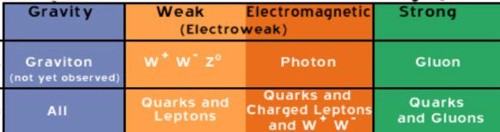
The Z boson, W- boson, and W+ boson operate over very tiny inter-atomic distances (10^-18 meters), carrying the weak force. The Higgs boson (graviton), postulated to carry the force of gravity, may have been discovered in 2012 at the Large Hadron Collider at CERN in Geneva. If it exists, theory predicts that it has a mass greater than 125 Gev.
Another model proposes a different particle, the axion, that is one trillionth the mass of an electron. It will take quite a few of them to make up the missing mass.
Dark matter is weakly or non-interacting, so it is
called nonbaryonic matter. It's composition is as
yet unknown.
Atomic Number (Z)
represents the number of protons in an atom and
uniquely identifies a chemical element. The number
of electrons surrounding the nucleus equals the
number of protons.
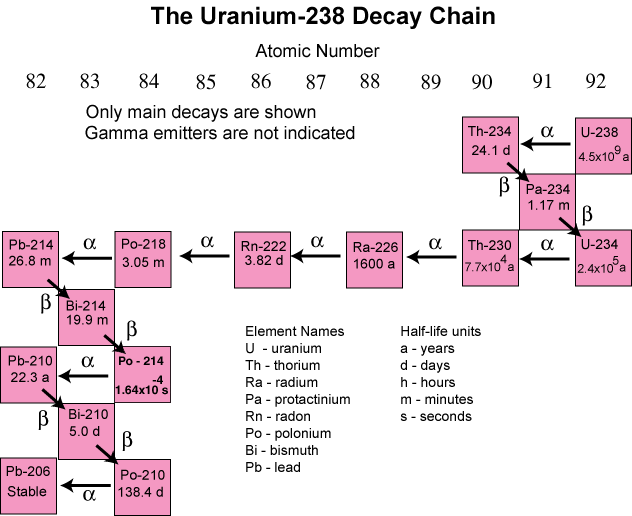
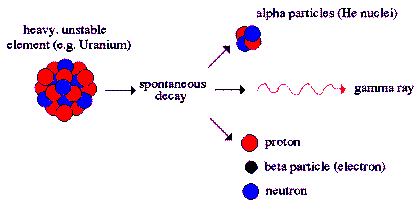
Unstable isotopes decay to more stable forms, some of which may be unstable and decay further. The decay process gives off radiation. The time it takes for the unstable material to decay to one half its original mass is called the half life. For example, 93% of potassium atoms have 19 protons with 20 neutron and are stable, giving an atomic number of 19 and an atomic weight of 39. One particular isotope has 21 neutrons, giving an atomic weight of 40. It is unstable and comprises only 0.012% of all Potassium atoms. Other isotopes, some stable, some not, make up the remaining 7% of the atoms.
Atoms in a
radioactive substance decay in a random
fashion but at a characteristic rate. The
length of time this takes, the number of
steps required, and the kinds of radiation
released at each step are well known from
laboratory measurements and quantum theory
calculations.
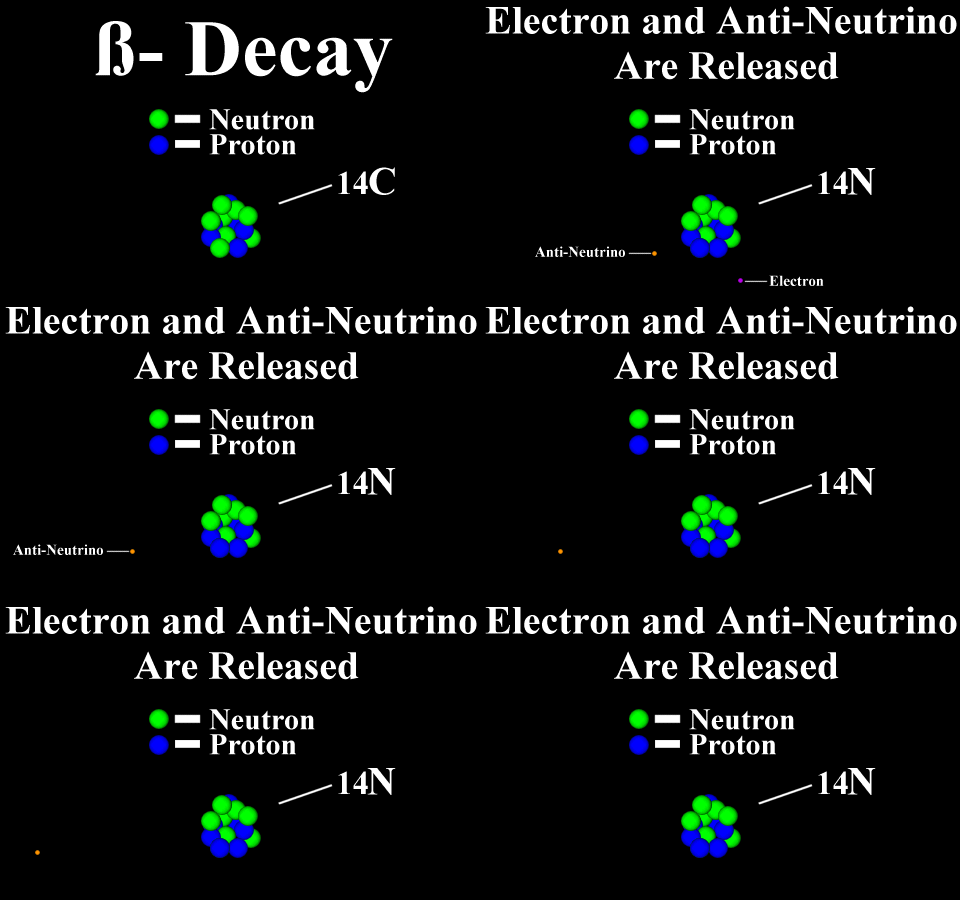
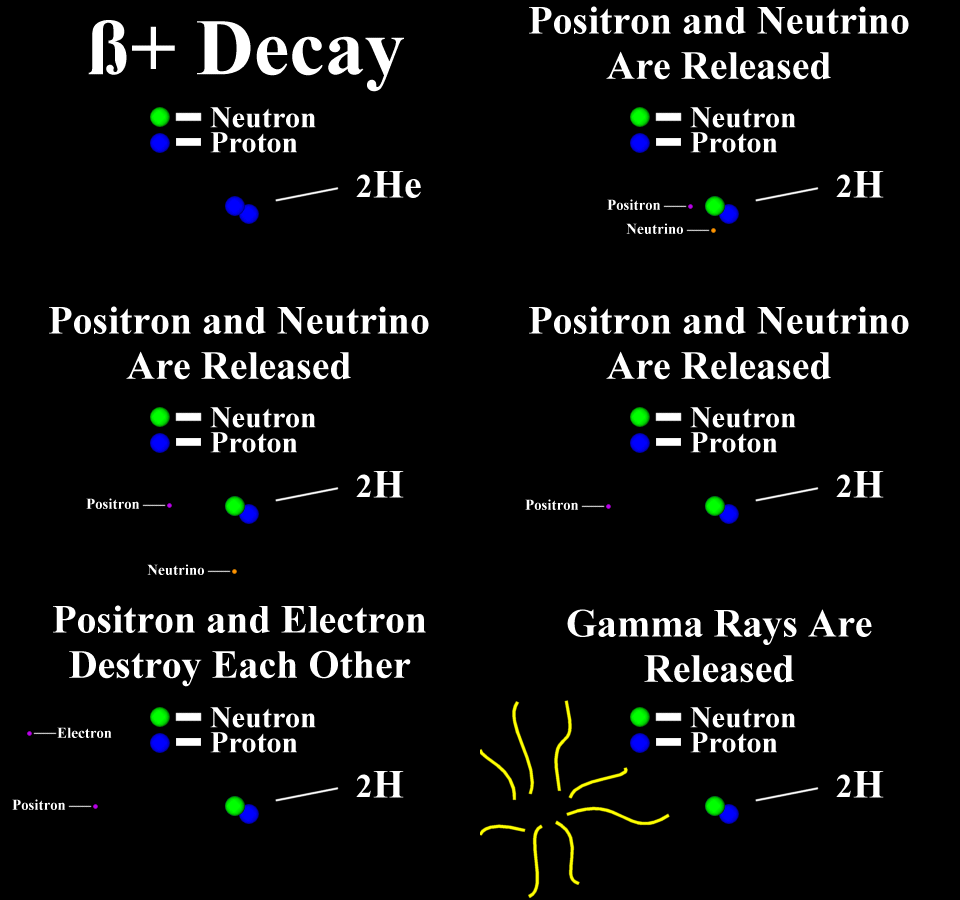
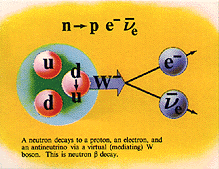
In the case of a positron emission, a proton is converted into a neutron and is called "beta plus". The positron is quickly annialated by a nearby electron and two gamma rays are emitted. the atomic number is decreased by 1. For Potasium-40, beta-minus results in Calcium-40 and Beta-plus results in Argon-40. Both daughter products are stable. Gamma rays are produced in Beta-plus but not Beta-minus events.
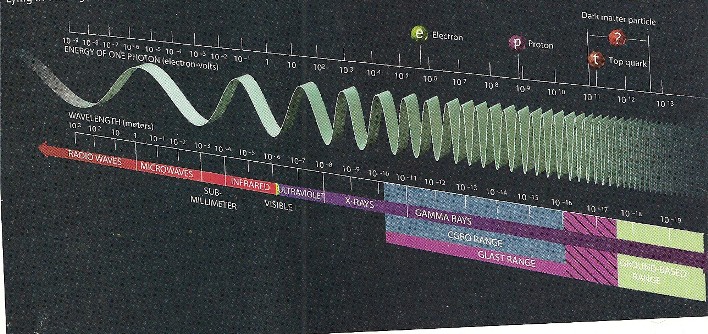
Gamma Rays
are
high energy photons,
a form of
electromagnetic
radiation, produced
by sub-atomic
particle
interactions, such
as electron-positron
annihilation or
radioactive decay.
Gamma rays are
generally
characterized as
having the highest
frequency and
energy, and also the
shortest wavelength
(below about 10 picometers).
Hard X-rays overlap the range of long-wavelength (lower energy) gamma rays, however the distinction between the two terms depends on the source of the radiation, not its wavelength; X-ray photons are generated by energetic electron processes, gamma rays by transitions within atomic nuclei. Due to their high energy content, X-rays and gamma rays can cause serious damage when absorbed by living cells.
In well logging, the natural gamma radiation from rocks is used to to assist in assessing mineralogy of the rocks. Another well logging tool emits neutrons, either from a chemical or accelerator source in the logging tool, to help assess mineralogy and porosity. Instruments that emit gamma rays are also used for similar purposes.
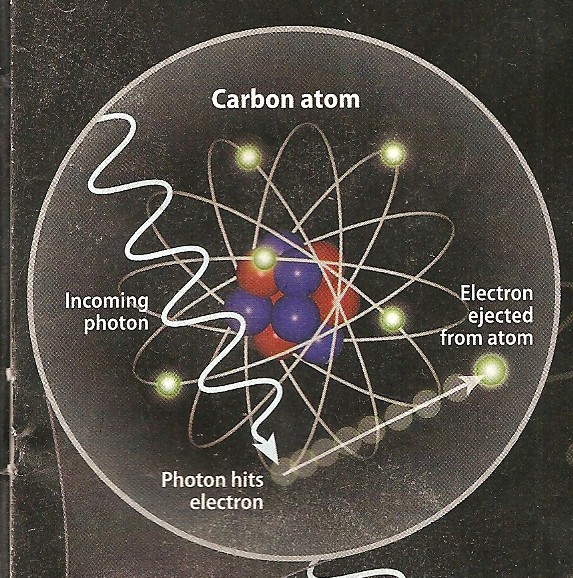
The photoelectric
effect takes place with photons with energies from
about a few electronvolts to over 1
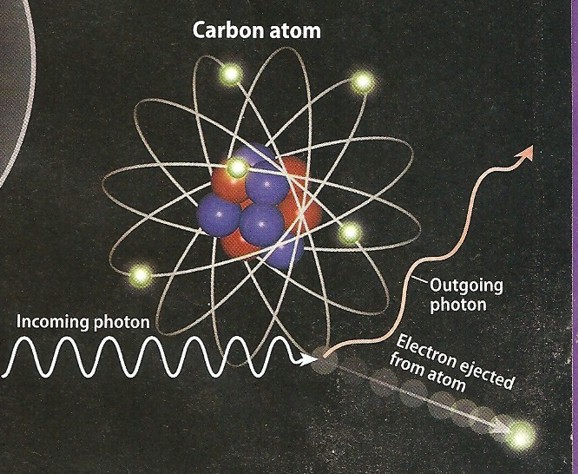
MeV. At higher photon energies comparable to the
electron rest energy of 511 keV, Compton scattering
takes place, and above twice this (1.022 MeV) pair
production takes place. However, like all
radioactive events, these reactions are statistical
in nature, so there is no distinct energy boundary
between the three processes.
In well logging, Compton scattering of gamma rays is used to measure the electron density of rocks. This is transformed into density in grams/cc. At the same time, the energy of the scattered gamma rays is measured and transformed into a value called the Photo Electric Effect (PEF), This is a little confusing since the measurement is made from scattered gamma rays, and not from a direct measure of the ejected electrons, as was done in the 1905 Einstein experiment.
|
|
||||
|
Page Views ---- Since 01 Jan 2015
Copyright 2023 by Accessible Petrophysics Ltd. CPH Logo, "CPH", "CPH Gold Member", "CPH Platinum Member", "Crain's Rules", "Meta/Log", "Computer-Ready-Math", "Petro/Fusion Scripts" are Trademarks of the Author |
|||||


|
||
| Site Navigation | BASIC PHYSICS SUBATOMIC PARTICLES ATOMS RADIATION THEORIES | Quick Links |

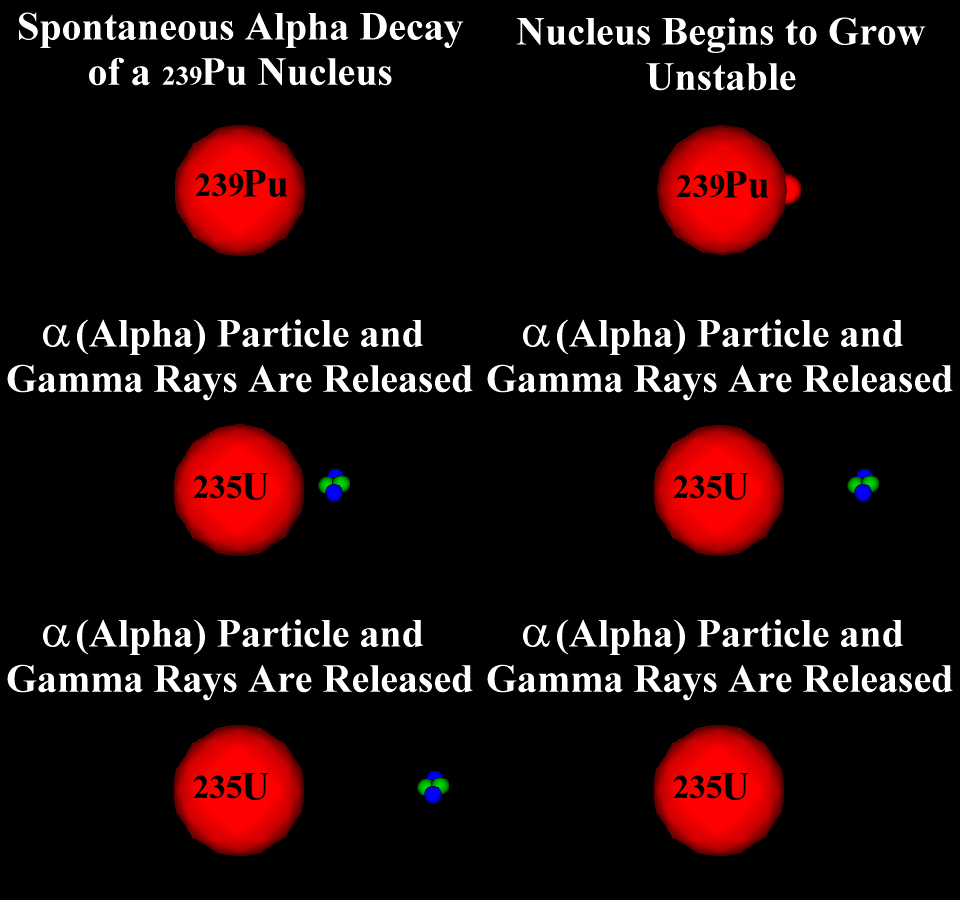
 There
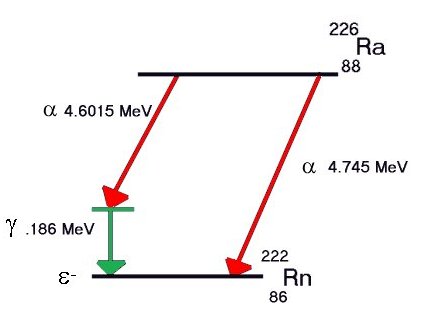
is a difference in mass between the original nucleus
and the sum of the mass of the
There
is a difference in mass between the original nucleus
and the sum of the mass of the
 particle and
resulting nucleus. This lost mass is converted into
energy using the formula E = mc2;
the energy would equal the kinetic energy of the
particle and
resulting nucleus. This lost mass is converted into
energy using the formula E = mc2;
the energy would equal the kinetic energy of the
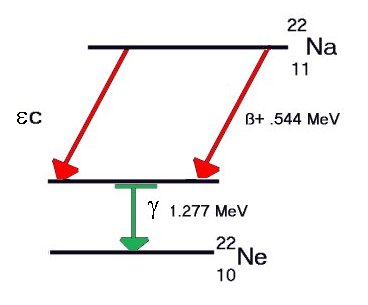 A
third form of Beta decay, called Inverse Beta, or
Electron Capture, converts a proton to a neutron by
capturing an inner shell electron, and emitting the
excess energy as a low energy gamma ray (X-ray). For
Potassium-40, this mode of decay also results in
stable Argon-40. Since K-40 has a half-life of more
than a billion years, gamma rays are constantly
being produced and can be detected by conventional
instrumentation.
A
third form of Beta decay, called Inverse Beta, or
Electron Capture, converts a proton to a neutron by
capturing an inner shell electron, and emitting the
excess energy as a low energy gamma ray (X-ray). For
Potassium-40, this mode of decay also results in
stable Argon-40. Since K-40 has a half-life of more
than a billion years, gamma rays are constantly
being produced and can be detected by conventional
instrumentation.