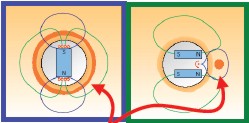
Laboratory NMR apparatus used for medical diagnosis consists of
a magnet which provides a strong, steady magnetic field that is
as uniform as possible and a coil that produces an oscillating
magnetic field perpendicular to the static field direction. A
relatively small, compact sample, such as a person, is placed inside
the coil. For borehole NMR, the sample - namely the Earth - is not
inside the measurement apparatus, but outside of it. It requires a
leap of imagination to see how NMR measurements can be made
"inside-out" on a sample external to the apparatus.
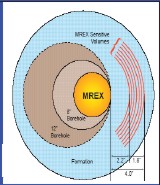
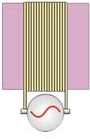
All modern NMR tools use a permanent magnet to align the proton spin axis of the reservoir fluid. Older tools (1960 - 1988+/-) relied on the Earth's magnetic field as the permanent magnet. This probably accounts for their lousy performance and unreliable results. All tools use a radio frequency transmitter - receiver to tip the spin axis, then record the electromagnetic signal emitted by the protons as they process back to their original spin direction. The transmitter operates at the Larmor frequency, which depends on the strength of the permanent magnet on the tool. On a CMR, for hydrogen, this is 3.8 MHz. The rate of decay of the emitted energy is transformed into a moveable fluids measurement, and on newer tools, a measure of irreducible and clay bound water are also obtained. Unlike many other logging tools, the NMR design and operating principles are somewhat different between different service suppliers. A Schlumberger CMR tool investigates a chunk of rock about the size of a good Cuban cigar, about 1 inch from the borehole wall, in front of the permanent magnet on the face of the tool. Halliburton's MRIL tool (NUMAR design) measures a thin cylinder about 2 inches inside the rock, circling the entire borehole. The Baker Atlas MREX tool sees a 120 degree segment of a cylinder about 2 inches into the rock.
Spinning bar magnets are pretty common in nature. Individual iron atoms, the Earth, the Sun, several planets and neutron stars are all spinning bar magnets. The Earth is a more complicated spinning bar magnet than an atomic nucleus, because the geographical north pole (spin axis) of the Earth does not coincide with its magnetic north pole. Nuclei are better behaved: their magnetic and geographical poles coincide exactly. The hydrogen nucleus, which consists of a single proton, is magnetic and an abundant component of water, gas, and oil.
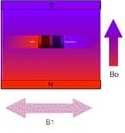
The first step of a modern NMR measurement is to align the nuclear magnets with a strong magnetic field. This makes them line up, with north poles of the nuclei pointing to the south pole of the magnet. All the magnets are in a uniform equilibrium (low energy) state. The second step is to apply another magnetic field at 90 degrees to the first, and in resonance with the nuclear motion.
When a nucleus is tipped away from the direction of the strong magnetic field, it too precesses. The precession speed depends on the properties of the nucleus (rate of spin, etc.) and the strength of the magnetic field — very similar to the gyroscope. These properties never change, so all we need to know is the strength of the magnetic field to accurately predict the precession frequency. That's the frequency we must apply to get the nucleus tipped away from the main magnetic field and precessing. motion. Step three is to turn off the resonant magnetic field. Precession will continue for quite a while. All we need is a quick burst of radio waves, lasting maybe 10 microseconds to keep them going for as much as several seconds. As long as the nuclei are out of alignment with the big magnet (out of equilibrium) they radiate radio waves. Part of the NMR equipment is a radio receiver, to catch the emissions from the nuclei while they are moving. The first NMR apparatus was built with old World War II radar sets, which have both a radio transmitter and receiver in one unit. The precession of the nucleus will find a way to slowly return to equilibrium, oriented with the field of the permanent magnet in the NMR tool.
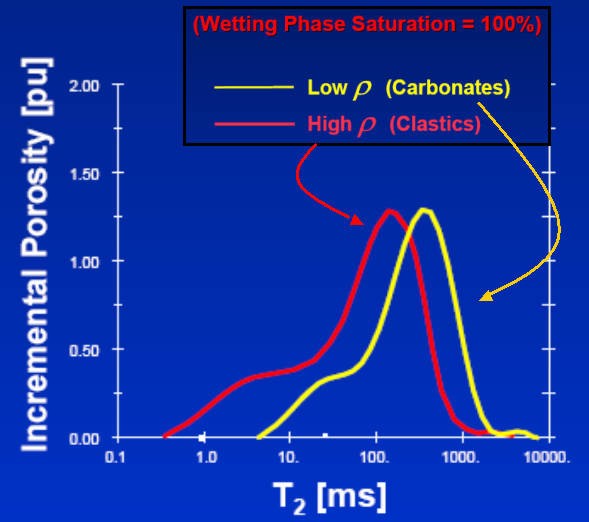
In larger pores the fluid molecules have more room to move around without bumping into the walls, so these collisions are less frequent. In a rock, NMR relaxation depends on the size of the pores: the larger the pores, the longer the NMR relaxation time.
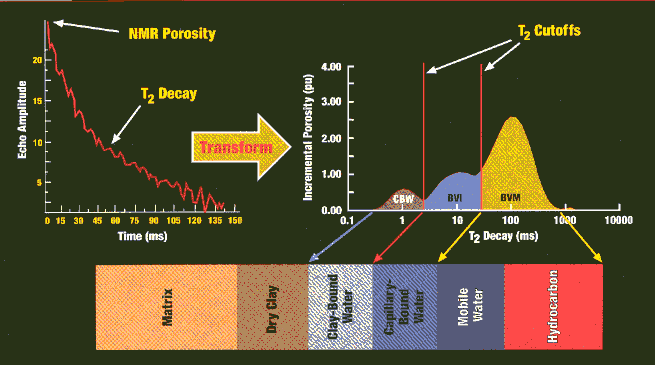
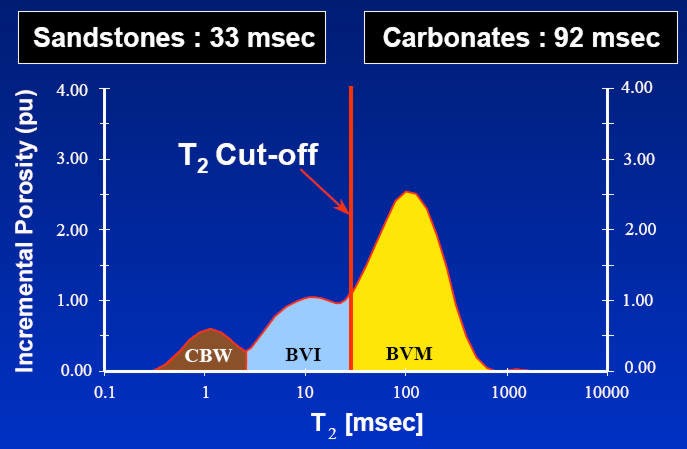
The second application of NMR data is to determine a distribution of pore sizes. Since pores within a single rock can vary greatly in size, the distributions are very broad. The pore size distribution tells geologists a lot about a rock. Apart from pore size and pore size distribution, the chief application of the NMR tool is to determine moveable fluid volume of a rock. This is the pore space excluding clay bound water (CBW) and irreducible water (BVI). Neither of these are moveable in the NMR sense, so these volumes are not easily observed on older logs. On modern tools both CBW and BVI can often be seen in the signal response after transforming the relaxation curve to the porosity domain. Note that some of the moveable fluids (BVM) in the NMR sense are not actually moveable in the oilfield sense of the word. Residual oil and gas, heavy oil, and bitumen may appear moveable to the NMR precession measurement, but these will not necessarily flow into a well bore.
The matrix and dry clay terms of NMR response are zero. As a result the NMR porosity is said to be independent of lithology. However, this is only true for total porosity (the total area under the shaded curve in the above illustration). The boundary between CBW and BVI, and the boundary between BVI and BVM, do depend on lithology and may vary foot by foot through the reservoir. As a result, the choice of fixed T2 cutoff times to represent these boundaries is not a good idea, and more elaborate methods are now being used. An NMR log
run today can display clay bound water (CBW), irreducible water
(capillary bound water, BVI), and mobile fluids (hydrocarbon plus
water, BVM), also called free fluids or free fluid index (FFI).
On older logs, only free fluids (FFI) are recorded and some subtractions,
based on other open hole logs, are required to obtain BVI and
CBW. |
|
||||||||
|
Page Views ---- Since 01 Jan 2015
Copyright 2023 by Accessible Petrophysics Ltd. CPH Logo, "CPH", "CPH Gold Member", "CPH Platinum Member", "Crain's Rules", "Meta/Log", "Computer-Ready-Math", "Petro/Fusion Scripts" are Trademarks of the Author |
|||||||||


|
||
| Site Navigation | BASIC PHYSICS NUCLEAR MAGNETIC RESONANCE | Quick Links |

 NUCLEAR MAGNETIC RESONANCE BASICS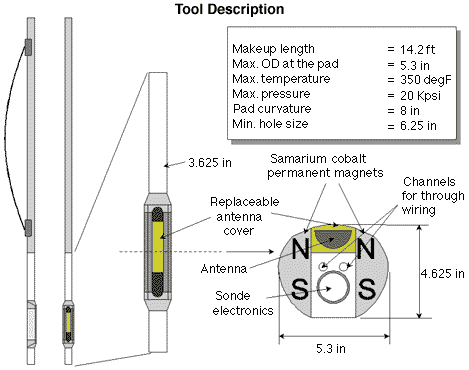
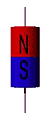 Many (though not
all) atomic nuclei can be thought of as very small bar magnets, with
a north pole and a south pole. The nuclei spin at a constant rate,
with the spin axis exactly coinciding with the line between the
north and south poles.
Many (though not
all) atomic nuclei can be thought of as very small bar magnets, with
a north pole and a south pole. The nuclei spin at a constant rate,
with the spin axis exactly coinciding with the line between the
north and south poles.
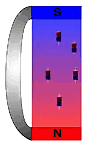 Ordinarily, the
north poles of nuclei point in random direction, but many are
roughly aligned with the Earth's magnetic field.
Ordinarily, the
north poles of nuclei point in random direction, but many are
roughly aligned with the Earth's magnetic field. 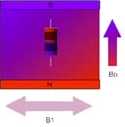
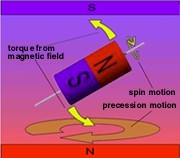 Because the nucleus is spinning, it behaves
like a gyroscope or toy top. When a gyro or top is pointing straight
up in the earth's gravitational field, it just spins. But if it tips
away from vertical it goes into an orbital motion called
precession. The precession speed, which is much slower than the spin
speed, depends on the size and shape of the gyro, its spin speed, and
the strength of gravity.
Because the nucleus is spinning, it behaves
like a gyroscope or toy top. When a gyro or top is pointing straight
up in the earth's gravitational field, it just spins. But if it tips
away from vertical it goes into an orbital motion called
precession. The precession speed, which is much slower than the spin
speed, depends on the size and shape of the gyro, its spin speed, and
the strength of gravity.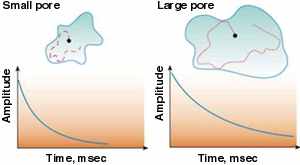 There are many ways for a nucleus to lose energy and
return to equilibrium. One way, if the nucleus is in a liquid
molecule, like water, is when it hits a solid surface. Every time
the molecule hits a solid surface, the nucleus has a chance to
return to happy alignment along the strong magnetic field. This is
called relaxation.
There are many ways for a nucleus to lose energy and
return to equilibrium. One way, if the nucleus is in a liquid
molecule, like water, is when it hits a solid surface. Every time
the molecule hits a solid surface, the nucleus has a chance to
return to happy alignment along the strong magnetic field. This is
called relaxation. 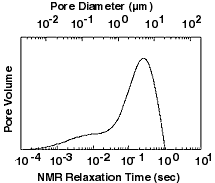 The sensitivity of NMR to pore size has two simple, but very
powerful, applications. The first is to estimate permeability, which is
determined by the size of its pores. More precisely, the
permeability is proportional to the square of the diameter of the
pores, so one expects the permeability to be proportional to the
square of the NMR relaxation time. We have confirmed this
relationship by doing laboratory tests on hundreds of different
kinds of rocks.
The sensitivity of NMR to pore size has two simple, but very
powerful, applications. The first is to estimate permeability, which is
determined by the size of its pores. More precisely, the
permeability is proportional to the square of the diameter of the
pores, so one expects the permeability to be proportional to the
square of the NMR relaxation time. We have confirmed this
relationship by doing laboratory tests on hundreds of different
kinds of rocks.