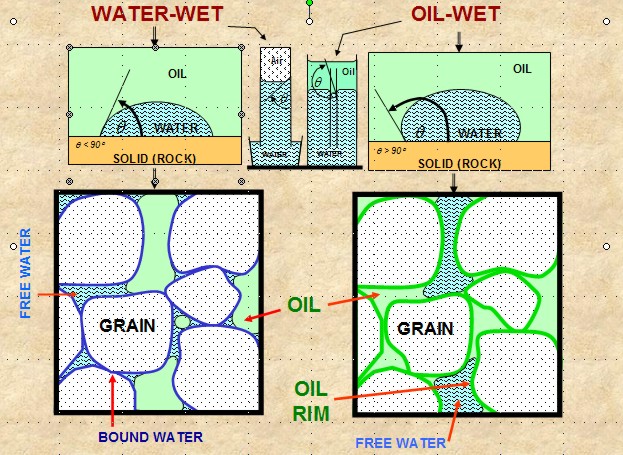
Wettability is defined by
the contact angle of the fluid with the solid phase.
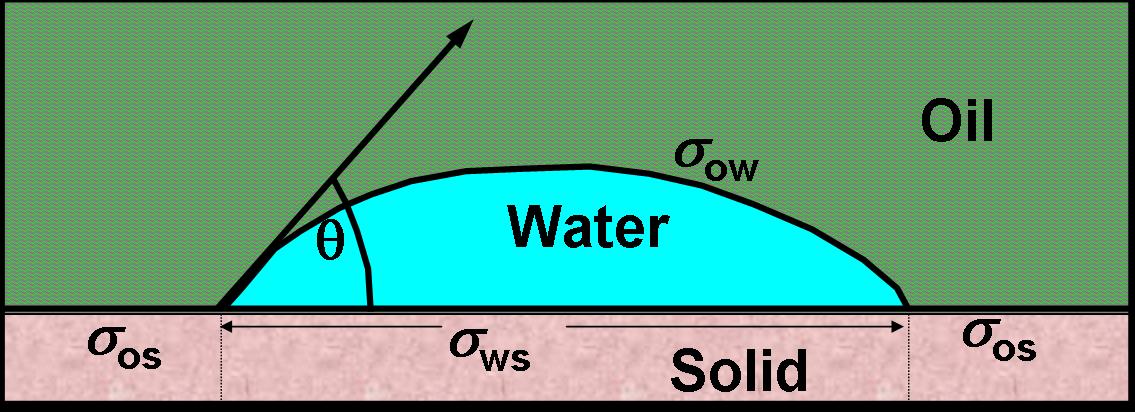
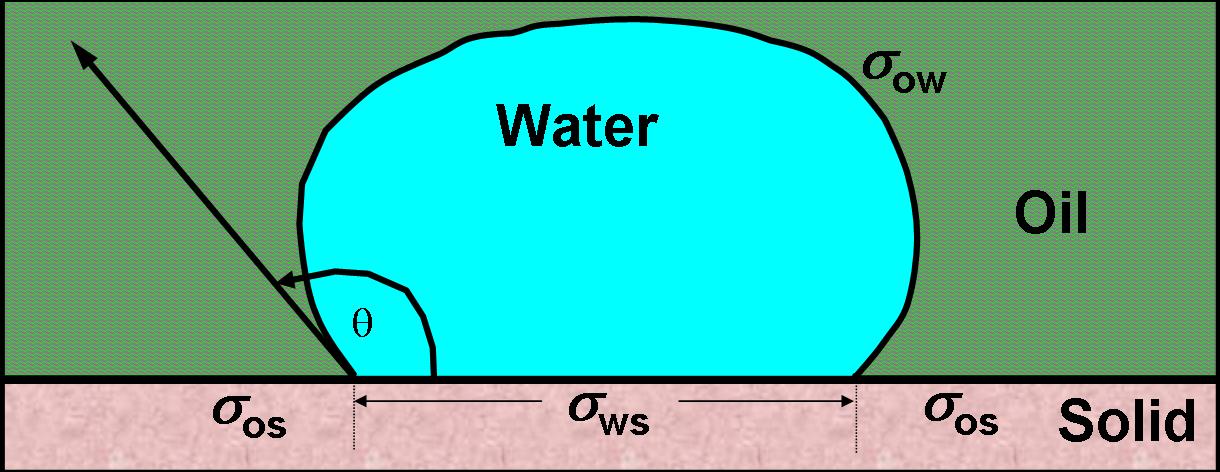
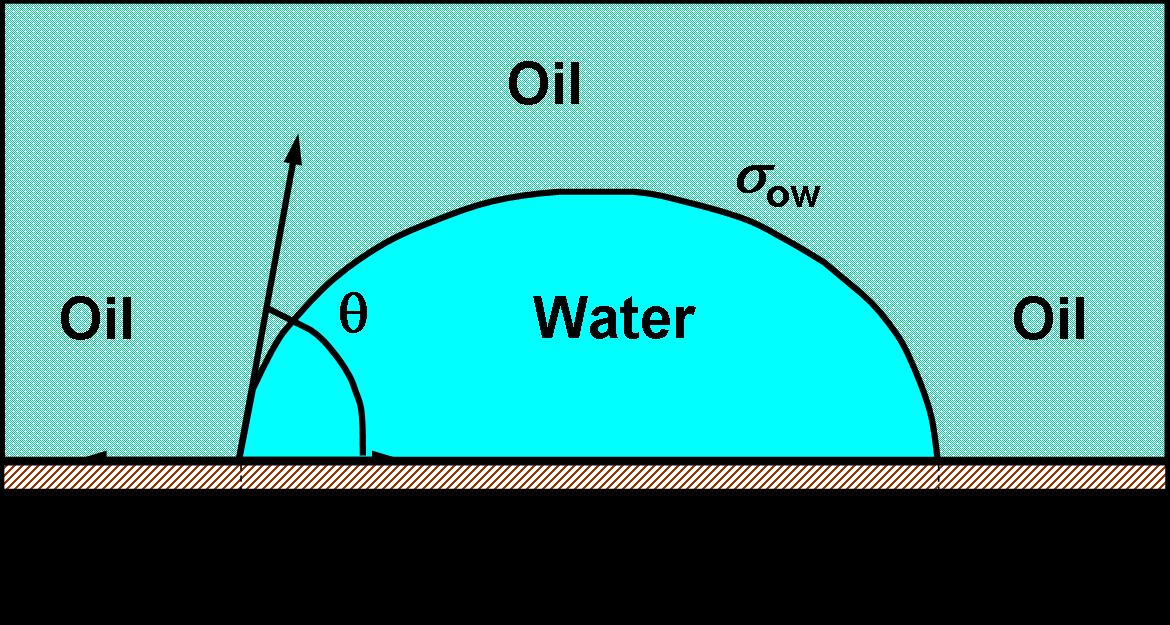 Adhesion tension (AT) is expressed as the difference between two solid-fluid interfacial tensions. A negative adhesion tension indicates that the denser phase (water) preferentially wets the solid surface (and vice versa). •An adhesion tension of 0.0 indicates that both phases have equal affinity for the solid surface.
When 2 or more
fluids are present, there are at least 3 sets of
forces acting on the fluids and affecting
hydrocarbon recovery.
 DEFINITIONS
AT = adhesion tension
THETA = contact angle
between the
oil/water/solid
interface measured
through the water
SIGMAos
=
interfacial energy
between the oil and
solid
SIGMAws =
interfacial energy
between the water and
solid
SIGMAow
=
interfacial energy
(interfacial tension)
between the oil and
water
Reservoir
rock is
water
wet
if water preferentially
wets the rock surfaces.
The rock
is water wet under the
following conditions:
SIGMAws >=
SIGMAos
AT
< 0
(i.e., the adhesion
tension is negative)
•
0°
<= THETA <=
90°
When THETA is close to 0°, the rock is considered to be “strongly water wet”.
•
Reservoir rock is oil-wet if oil preferentially wets the rock surfaces. •The rock is oil wet under the following conditions:
•
SIGMAos >=
SIGMAws
A T > 0 (i.e., the adhesion tension is positive) 90° <= THETA <= 180° When THETA is close to 180°, the rock is considered to be “strongly oil wet”
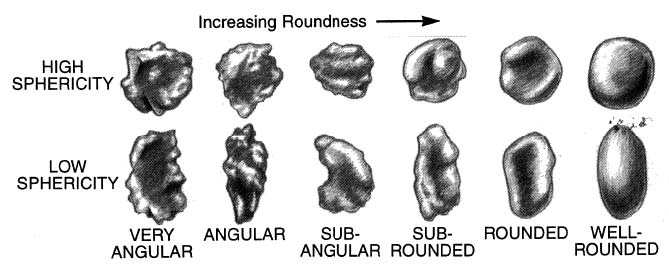
Wettability is classified by its variations; Strongly oil or water wetting. Neutral wettability – no preferential wettability to either water or oil in the pores. Fractional wettability – reservoir that has local areas that are strongly oil-wet, whereas most of the reservoir is strongly water-wet - occurs where reservoir rock has variable mineral composition and surface chemistry. Mixed wettability – smaller pores are water wet and filled with water, whereas larger pores are oil wet and filled with oil. Residual oil saturation is low - occurs where oil with polar organic compounds invades a water-wet rock saturated with brine. Wettability varies with surface roughness, so the wettability of a rock will vary with grain shape, size, and rounding.
The current measuring method uses a modern contact angle goniometer and is called the static sessile drop method. The contact angle goniometer is an optical subsystem which capture the profile of a pure liquid on a solid substrate. The angle formed between the liquid/solid interface and the liquid/vapor interface is the contact angle. Older systems used a microscope optical system with a back light. Current-generation systems employ high resolution cameras and software to capture and analyze the contact angle. The dynamic sessile drop method is similar to the static sessile drop but requires the drop to be modified. A common type of dynamic sessile drop study determines the largest contact angle possible without increasing its solid/liquid interfacial area by adding volume dynamically. This maximum angle is the advancing angle. Volume is removed to produce the smallest possible angle, the receding angle. The difference between the advancing and receding angle is the contact angle hysteresis.
If a
water-wet rock saturated
with oil is
placed in
water, it will imbibe
water into the smallest pores,
displacing oil. If
an oil-wet rock
saturated with water is
placed in
oil, it will imbibe oil
into the smallest
pores, displacing
water.
Drainage is a fluid flow process in which the saturation of the nonwetting phase increases. Mobility of nonwetting fluid phase increases as nonwetting phase saturation increases e.g., waterflood of an oil reservoir that is oil wet Gas injection in an oil or water wet reservoir. Pressure maintenance or gas cycling by gas injection in a retrograde condensate reservoir. A water-wet reservoir that accumulation of oil or gas in a trap does so by drainage.
Primary and waterflood oil recovery is affected by the wettability of the system. A water-wet system will exhibit greater primary oil recovery.
|
|
||
|
Page Views ---- Since 01 Jan 2015
Copyright 2023 by Accessible Petrophysics Ltd. CPH Logo, "CPH", "CPH Gold Member", "CPH Platinum Member", "Crain's Rules", "Meta/Log", "Computer-Ready-Math", "Petro/Fusion Scripts" are Trademarks of the Author |
|||


|
||
| Site Navigation | LAB TECH MEASURING WETTABILITY OF POROUS ROCKS | Quick Links |
 Wetting
phase fluid preferentially wets
the solid rock surface. Attractive
forces between rock and fluid
draw the wetting phase into
small pores. Wetting phase fluid
often has low mobility.
Wetting
phase fluid preferentially wets
the solid rock surface. Attractive
forces between rock and fluid
draw the wetting phase into
small pores. Wetting phase fluid
often has low mobility.
 Nonwetting
phase does not preferentially
wet the solid rock surface.
Repulsive forces between rock
and fluid cause nonwetting phase
to occupy largest pores.
Nonwetting phase fluid is often
the most mobile fluid,
especially at large nonwetting
phase saturations. Natural gas is
never the wetting phase in
hydrocarbon reservoirs.
Nonwetting
phase does not preferentially
wet the solid rock surface.
Repulsive forces between rock
and fluid cause nonwetting phase
to occupy largest pores.
Nonwetting phase fluid is often
the most mobile fluid,
especially at large nonwetting
phase saturations. Natural gas is
never the wetting phase in
hydrocarbon reservoirs.