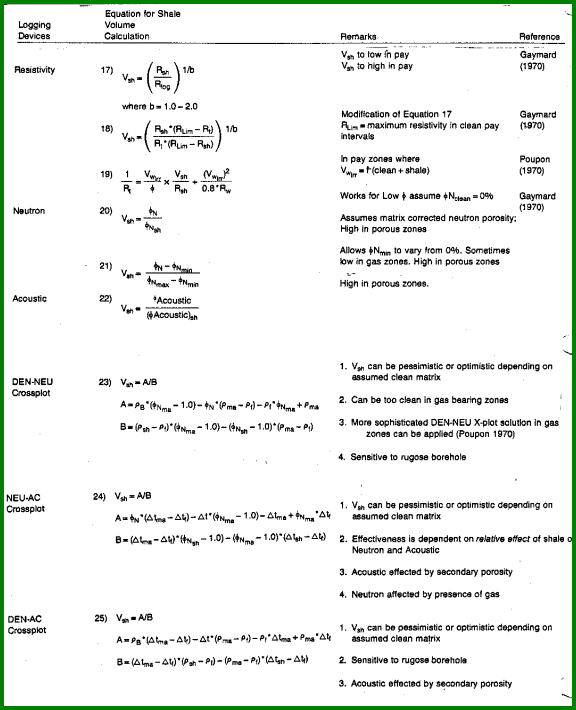
A number of useful shale volume methods have more restricted The reader should take a moment to define the parameters and work a hypothetical numerical example.
1.
VSHept = (ATTEN - ATTEN_CLN) / (ATTEN_SHL - ATTEN_CLN)
The clean and shale resistivity values can be picked from suitable cross plots or from depth plots. For the resistivity log method, the use of the logarithm of the resistivity log values (and base line values) works better than linear values, as follows:
3. VSHresd = (log(RESD) - log(RESD_CLN)) / (log(RESD_SHL)
- log(RESD_CLN)) Note that RESD_CLN is greater than RESD_SHL
7. VSHsig = (SIGMA – SIG_CLN) / (SIG_SHL – SIG_CLN)
All cased hole thermal decay time logs display a SIGMA curve as one of the primary measurements. Although there are hydrocarbon effects, the curve can sometimes be used to overcome problems with the gamma ray log, such as uranium precipitation on casing or tubing, or missing GR log.
9. VSHpe = (PE – PE_CLN) / (PE_SHL – PE_CLN) PE of quartz is between 1.6 to 1.8 and illite shale is near 3.5. l
|
|
||
|
Page Views ---- Since 01 Jan 2015
Copyright 2023 by Accessible Petrophysics Ltd. CPH Logo, "CPH", "CPH Gold Member", "CPH Platinum Member", "Crain's Rules", "Meta/Log", "Computer-Ready-Math", "Petro/Fusion Scripts" are Trademarks of the Author |
|||


|
||
| Site Navigation | SHALE VOLUME ALTERNATE MODELS | Quick Links |
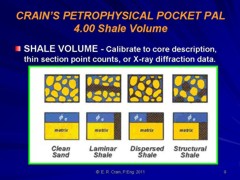
 Other Shale Volume Methods