|
 Crain's Usage Rules For Shale Volume MethoDS
The methods shown on other pages of this Handbook provide
numerous independent approaches
for calculating
shale volume, as well as a number of correction factors
which could be applied. If the results differ significantly
from each other, then the log scales should be checked,
and then the clean lines, shale lines, and log picks reviewed in an attempt to reconcile
the differences. If no reconciliation can be made, discard
the least trustworthy result. In order of preference, it
is suggested you use:
BEST METHODS
1. Vsh Minimum Method
Choose from minimum of feasible fsresults (at each depth
point) if there is no reason to prefer
one method over another.
2. Vsh from gamma ray (GR)
Use if sandstone or carbonate is not radioactive
due to uranium.
Use linear methods unless local correlations have shown
a need for a non-linear relationship.
3. Vsh from thorium (TH)
Use if sandstone or carbonate is
radioactive due to uranium
4. Vsh from density neutron
Use if hole condition is
good. Best suited to feldspar or quartz sands with no
heavy minerals and no gas.
METHODS WITH LIMITED USE
5. Vsh from SP.
Use only if SP has sufficient character or resolution
to be believed.. May be useful if SP is the only shale
indicating curve available.
6. Vsh from sonic density crossplot.
Do not use the Q method..
7. Vsh from deep resistivity log.
Useful only in hydrocarbon bearing
zones DO NOT use in water zones. Useful in heavy
oil and bitumen oil zones..
8. Numerous alternate methods
May work in specific areas.
Computer
generated plots of the results for the mixed lithology example
are displayed below. The crossplot shale values
are not valid because heavy minerals affect the results.
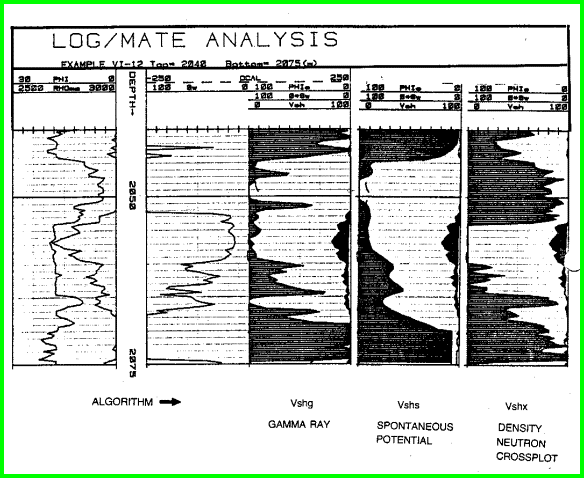
Comparison of Shale Calculation Methods for
Mixed Lithology Example
TRIMming Shale Volume
RESULTS
Trims may be needed to remove Vsh results below 0.00 and
above 1.00 before display or use in other calculations, for
example:
1: Vshg = Max(0, Min(1, Vshg))
Minimum Shale VolumeMETHOD
The usual approach for deciding which of the several available
shale volume results to use is to find the minimum value
of the feasible results. Feasible results do not include
answers from the crossplot methods if gas crossover occurs.
The minimum is chosen because most errors for any one method
tend to increase the apparent shale volume. For example,
radioactive sandstone would appear very shaly from the gamma
ray but reasonable from the SP and density neutron crossplot.
High resistivity zones subdue the SP, making it give too high
a value for Vsh. Heavy minerals force the density neutron
method to likewise give too high a value for Vsh.
A simple model for handling this is:
1:
IF PHIN < PHID
! If gas crossover
2: THEN VSHxnd = 10^6
! Vshxnd cannot be the minimum
3: VSHmin = Min(VSHgr, VSHsp, VSHxnd, ......)
Where:
PHID = density log reading (fractional)
PHIN = neutron log reading (fractional)
VSHnin = shale volume from minimum method (fractional)
VSHgr = shale volume from gamma ray method (fractional)
VSHsp = shale volume from SP method (fractional)
VSHxnd = shale volume from density neutron crossplot method
(fractional)
COMMENTS:
Add other VSH models if they seem to work for a particular
project or zone.
|