Return To Handbook IndexRoss Crain's Resume
W
ELCOME  TO
CRAIN'S PETROPHYSICAL HANDBOOK

 Please be fair to the author. Pay your Shareware fee HERE, and receive the CD-ROM at no extra cost.

TOTAL ORGANIC CARBON (TOC)

Total Organic CARBON (TOC)
Organic carbon is the remnant of ancient life preserved in sedimentary rocks, after degradation by bacterial and chemical processes, and further modified by temperature, pressure, and time. The latter step, called thermal maturation, is a function of burial history (depth) and proximity to heat sources. Maturation provides the chemical reactions needed to give us gas, oil, bitumen, pyrobitumen, and graphite (pure carbon) that we find while drilling wells for petroleum.


<== Pathways that convert living organisms to organic carbon, from "Bitumens, Asphalts, and Tar Sands" by George V. Chilingar, Teh Fu Yen, 1978.

Organic carbon is usually associated with shales or silty shales, but is also present in many carbonate rocks. Total organic carbon (TOC) is mainly used to assess the quality of source rocks, but may also be used to help evaluate some unconventional reservoirs (reservoirs that are both source and productive).

A source rock is a fine grained sediment rich in organic matter that could generate crude oil or natural gas after thermal alteration of kerogen in the Earth's crust. The oil or gas could then migrate from the source rock to more porous and permeable sediments, where ultimately the oil or gas could accumulate to make a commercial accumulation. If a source rock has not been exposed to temperatures of about 100 °C, it is termed a potential source rock. If generation and expulsion of oil or gas have occurred, it is termed an actual source rock. The terms immature and mature are commonly used to describe source rocks.

Organic carbon is often taken to mean kerogen, but both laboratory and log analysis models may have difficulty segregating kerogem from ordinary hydrocarbons such as oil, bitumen, or pyrobitumen in porosity.

Graphite filled porosity is evident on resistivity logs because of the very low resistivity; all other forms of organic carbon are resistive.

Organic carbon has a density near that of water, so it looks like porosity to conventional porosity logs. High resistivity with some apparent porosity on a log analysis is a good indicator of organic carbon content.

Organic material can be classified according to the source of the material, as shown below.


Origin, type, source, and hydrocarbon potential of different kerogens. Organic content in gas shales is usually Type II, as opposed to coals, which contain mostly Type III

The hydrocarbon potential of organic carbon depends on the thermal history of the rocks containing the lerogen. Both temperature and the time at that temperature determine the outcome. Medium temperatures (< 175 C) produce mostly oil and a little gas. Warmer temperatures produce mostly gas..


Hydrocarbon type versus temperature
defines "oil window" and "gas window",
 with some obvious overlap ==>


Vitrinite reflectance (Ro) is used as an indicator of the level of organic maturity (LOM). Ro values between 0.60 and 0.78 usually represent oil prone intervals. Ro > 0.78 usually indicates gas prone. High values can suggest "sweet spots" for completring gas shale wells.


There is usually a strong correlation between TOC and adsorbed gas in gas shales. TOC correlations with gas content are sometimes used to predict specific gas content (Gc) instead of using detailed calculations with sorption curves.


ANALYSIS OF TOC IN THE LABORATORY
Analysis for TOC in the laboratory is done by pyrolysis and measuring changes in weight after water is driven off compared to weight after burning the organics. Vitrinite reflectance and other parameters are also measured, as shown in the example below


Depth (m)

TOC

SRA

Tmax

Meas.

HI

OI

S2/S3

S1/TOC*100

PI

Top

S1

S2

S3

(°C)

% Ro

X025

1.35

0.05

1.72

0.63

444


128

47

3

4

0.03

X040

1.18

0.05

1.65

0.57

443


140

49

3

4

0.03

X050

0.83

0.03

1.31

0.55

443


158

66

2

4

0.02

X065

0.80

0.04

1.00

0.58

440


126

73

2

5

0.04

X075

0.75

0.05

1.04

0.72

438


138

96

1

7

0.05

X090

1.04

0.09

2.52

0.29

452


241

28

9

9

0.03

X110

1.02

0.05

1.16

0.56

441


114

55

2

5

0.04

X135

1.05

0.05

1.32

0.57

443


125

54

2

5

0.04

Laboratory measured TOC values (weight %) with measured and computed indices


Organic content derived from sample chips or core plugs are processed to obtain the following indices:

  TOC = total organic carbon (wt%)
  Ro = vitrinite reflectance (%)
  Tmax = maximum temperature (deg C)
  S1 = volatile hydrocarbons                     (mg /gram of rock)

  S2 = remaining hydrocarbon potential  (mg /gram of rock)
  S3 = carbon dioxide content                   (mg /gram of rock)

Computed Values:
  Hydrocarbon Index
      1: HI = 100 * S2 / TOC  (mg / gram of TOC)


Oxygen Index
      2: OI = 100 * S3 / TOC  (mg / gram of TOC)

Production Index
      3: PI =  S1 / (S1 + S2)   (unitless)


A crossplot of HI vs OI determines kerogen type. è


                  Crossplots of HI vs Tmax and HI vs Ro determine organic maturity and kerogen type

Measured and calculated indices can be plotted versus depth; the log is called a Geochemical Log.


Geochemical log from a Baffin Shelf well  (Fowler, undated PDF)


Depth plot of Ro to determine trend line and location of oil and gas windows (Ro > 0.55)

Thermal maturity as indicated by vitrinite reflectance (Ro) versus depth for a Barnett shale, showing "sweet spot".and oil versus gas “windows”.


TOC is widely used as a guide to the quality of gas shales. Using correlaions of lab measured TOC and gas content (Gc), we can use log analysis derived TOC values to predict Gc, which can then be summed over the interval and converted to adsorbed gas in place. A sample correlation is shown below.


Crossplot of TOC versus Gc for a Tight Gas / Shale Gas example.

VISUAL ANALYSIS OF TOC FROM LOGS
Correlation of core TOC values to log data leads to useful relationships for specific reservoirs. The one shown below is for the Barnett shale. A strong correlation exists in some shales with Uranium content from the spectral gamma ray log. In other cases, the relationship is made with density, resistivity, sonic,  gamma ray, or combinations of these curves. Variations in matrix mineralogy strongly affect this type of correlation and it is possible that mineralogy will mask any trend with TOC.


<== Correlation of TOC with density in Barnett Shale. Similar crossplots of sonic or neutron data can be used for specific reservoirs where TOC data is available from core.


Visual analysis for organic content is based on the porosity - resistivity overlay technique, widely used to locate possible hydrocarbon shows in conventional log analysis. By extending the method to radioactive zones instead of relatively clean zones, organic rich shales (potential source rocks , gas shales, oil shales) can be identified. Usually the sonic log is used as the porosity indicator but the neutron or density log would work as well.

The trick here is to align the sonic log on top of the logarithmic scale resistivity log so that the sonic curve lies on top of the resistivity curve in the low resistivity shales. Low resistivity shales are considered to be non-source rocks and are unlikely to be gas shales. Shales or silts with source rock potential will show considerable crossover between the sonic and resistivity curves. The absolute value of the sonic and resistivity in the low resistivity shale are called base-lines, and these base-lines will vary with depth of burial and geologic age.

Schematic log showing sonic resistivity overlay in a variety of situations ==>


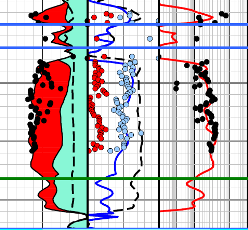
<== Sonic resistivity overlay showing crossover in Barnett Shale, Texas, labeled "ΔlogR" and shaded red.

Crossplots of porosity and logarithm of resistivity can also be used to define and segregate source rocks from non-source rocks. See "Identification of Source Rocks on Wireline Logs by Density-Resistivity and Sonic-Resistivity Crossplots" by B. L. Meyer and M. H. Nederlof,  AAPG Bulletin, V. 68, P 121-129, 1984..The best description of the method is posted on the online magazine Search and Discovery, in "Direct Method for Determining Organic Shale Potential from Porosity and Resistivity Logs to Identify Possible Resource Plays* by Thomas Bowman, Article #110128, posted June 14, 2010.

These crossplots usually show a non-source rock trend line  on the southwest edge of the data (similar to the water line on a Pickett plot) and a cluster of source rock data to the right of the non-source line, as shown in the image below. The slope and intercept of the non-source line is used to calculate a pseudo-sonic log, DtR, from the resistivity log, which can then be plotted on the same scale as the original sonic log.


Sonic versus logarithm of resistivity (DlogR) Crossplot showing non-source rock trendline and source rock cluster of data. The equation of the non-source rock line is DtR = 105 - 25 log(RESD) for this Barnett Shale example.

As for the manual overlay technique described above, crossover indicates source rock potential, shale gas, or an oil shale, or if the zone is clean, a potential hydrocarbon pay zone. An example of a DtR log is shown below.

Original sonic log (black curve) and calculated DtR curve (shaded red) showing potential source rock or, asin this case, gas shale (Barnett) ==>


PASSEY'S "DlogR" METHOD
Various methods for quantifying organic content from well logs have been published. The most common method is based on sonic versus resistivity. The method has been revised and modified by others. It is also known as the "D log R" method (with or without spaces and hyphens between the characters). The "D" was originally the Greek letter Delta (ΔlogR). See "A Practical Model for Organic Richness from Porosity and Resistivity Logs" by Q. R. Passey, S. Creaney, J. B. Kulla, F. J. Moretti
and J. D. Stroud,  AAPG Bulletin, V. 74, P 1777-1794, 1990.

The basic equations of the Passey model are:
      1: DlogR = log (RESD / RESDbase) + 0.02 * (DTC – DTCbase)
      2: Wtoc = DLogR * 10^(0.297 – 0.1688 * LOM)
      3: WT%toc = 100 * Wtoc


Where:
  RESD = deep resistivity in any zone (ohm-m)
  RESDbase =  deep resistivity baseline in non-source rock (ohm-m)
  DTC = compressional; sonic log reading in any zone (usec/ft)
  DTCbase = Sonic baseline in non-source rock (usec/ft)
  DlogR =
Passey’s number (fractional)
  LOM = level of organic maturity (unitless)
  Wtoc = total organic carbon (weight fraction)
  WT$toc = total organic carbon (weight percent)

Divide metric DTC values by 3.281 to get usec/ft

DTC and DTCbase can be replaced with DENS (g/cc) and PHIN (fractional) values, with a corresponding change in the constant (+0.02) to -2.5 for DENS and +4.0 for PHIN.

Density of TOC is about 0.94 to 0.98 g/cc.

Numerical Example:
RESD   RESDbase   DTC   DTCbase   LOM   DENS   DENSbase   PHIN   PHINbase
  25         4               100         62          8.5      2.35        2.65          0.34    0.15
  DTC DENS PHIN
   DlogR =  1.556 1.546 1.556
   Wtoc   =  0.113 0.113 0.113 weight fraction

In practice, it is rare to have both TOC laboratory measurements and reliable organic maturity data to assist in calibration. Chose a value for LOM that will result in a match with available TOC data. Vitrinite reflectance (Ro) values may be available and are converted to LOM with the graph below.  LOM is typically in the range of 6 to 12 but could be as low as 4.

Density of TOC is about 0.94 to 0.98 g/cc.


Graph for finding Level of Organic Maturity from Vitrinite Reflectance. Higher LOM reduces calculated TOC. Some petrophysicists do not believe this chart, snd use regression techniques on measured TOC to estimate LOM - see bottom illustration on this page for an example.

ISSLER'S METHOD
Dale Issler published a model specifically tuned to Western Canada in "Organic Carbon Content Determined from Well Logs: Examples from Cretaceous Sediments of Western Canada" by Dale Issler, Kezhen Hu, John Bloch, and John Katsube, GSC Open File 4362. It is based on density vs resistivity and sonic vs resistivity crossplots (other methods are also described in the above paper).

The crossplots were redrafted in Excel , as shown below, and a drop-through code developed to generate TOC, based on the lines on the graphs. No doubt there is a simpler way to code this, but I didn't have time to sort it out.

ç DTC vs RESD

DENS vs RESD  è  

TOC calculated from DELT vs RESD crossplot is most easily done by a series of IF statements. This can be coded into a spreadsheet or software package that allows user defined equations. Note that sonic and density data are in Metric units.

TOC calculated from DENS vs RESD crossplot gives similar results to the sonic approach, but the density model should not be used in large or rough borehole intervals. Intervals where the sonic log is skipping should be edited before use.

TOC_s - TOC from Sonic Resistivity Crossplot
TOC from Sonic Resistivity Crossplot
IF DELT <= (-195 * LOG(RESD) + 460) THEN TOCs = 0
IF DELT > (-195 * LOG(RESD) + 460) THEN TOCs = 1
IF DELT > (-195 * LOG(RESD) + 474) THEN TOCs = 2
IF DELT > (-195 * LOG(RESD) + 488) THEN TOCs = 3
IF DELT > (-195 * LOG(RESD) + 502) THEN TOCs = 4
IF DELT > (-195 * LOG(RESD) + 516) THEN TOCs = 5
IF DELT > (-195 * LOG(RESD) + 530) THEN TOCs = 6
IF DELT > (-195 * LOG(RESD) + 544) THEN TOCs = 7
IF DELT > (-195 * LOG(RESD) + 558) THEN TOCs = 8
IF DELT > (-195 * LOG(RESD) + 572) THEN TOCs = 9
IF DELT > (-195 * LOG(RESD) + 586) THEN TOCs = 10
IF DELT > (-195 * LOG(RESD) + 600) THEN TOCs = 11
IF DELT > (-195 * LOG(RESD) + 614) THEN TOCs = 12
IF DELT > (-195 * LOG(RESD) + 628) THEN TOCs = 13
IF DELT > (-195 * LOG(RESD) + 642) THEN TOCs = 14
IF DELT > (-195 * LOG(RESD) + 656) THEN TOCs = 15
IF DELT > (-195 * LOG(RESD) + 670) THEN TOCs = 16 
IF DELT > (-195 * LOG(RESD) + 684) THEN TOCs = 17 
IF DELT > (-195 * LOG(RESD) + 698) THEN TOCs = 18
IF DELT > (-195 * LOG(RESD) + 712) THEN TOCs = 19
IF DELT > (-195 * LOG(RESD) + 726) THEN TOCs = 20 
IF DELT > (-195 * LOG(RESD) + 740) THEN TOCs = 21
IF DELT > (-195 * LOG(RESD) + 754) THEN TOCs = 22
IF DELT > (-195 * LOG(RESD) + 768) THEN TOCs = 23
IF DELT > (-195 * LOG(RESD) + 782) THEN TOCs = 24
TOCs = TOCs_SCALE * TOCs - TOCs_OFFSET

TOC_D - TOC from Density Resistivity Crossplot
IF DENS < (150 * LOG(RESD) + 1670) THEN TOCd = 24
IF DENS < (155 * LOG(RESD) + 1695) THEN TOCd = 23
IF DENS < (160 * LOG(RESD) + 1720) THEN TOCd = 22
IF DENS < (166 * LOG(RESD) + 1745) THEN TOCd = 21
IF DENS < (170 * LOG(RESD) + 1770) THEN TOCd = 20
IF DENS < (176 * LOG(RESD) + 1795) THEN TOCd = 19
IF DENS < (183 * LOG(RESD) + 1820) THEN TOCd = 18
IF DENS < (190 * LOG(RESD) + 1845) THEN TOCd = 17
IF DENS < (197 * LOG(RESD) + 1870) THEN TOCd = 16
IF DENS < (211 * LOG(RESD) + 1895) THEN TOCd = 15
IF DENS < (218 * LOG(RESD) + 1920) THEN TOCd = 14
IF DENS < (225 * LOG(RESD) + 1945) THEN TOCd = 13
IF DENS < (232 * LOG(RESD) + 1970) THEN TOCd = 12
IF DENS < (239 * LOG(RESD) + 1995) THEN TOCd = 11
IF DENS < (246 * LOG(RESD) + 2020) THEN TOCd = 10
IF DENS < (253 * LOG(RESD) + 2050) THEN TOCd = 9
IF DENS < (260 * LOG(RESD) + 2080) THEN TOCd = 8
IF DENS < (267 * LOG(RESD) + 2110) THEN TOCd = 7
IF DENS < (274 * LOG(RESD) + 2140) THEN TOCd = 6
IF DENS < (281 * LOG(RESD) + 2170) THEN TOCd = 5
IF DENS < (288 * LOG(RESD) + 2200) THEN TOCd = 4
IF DENS < (295 * LOG(RESD) + 2232) THEN TOCd = 3
IF DENS < (302 * LOG(RESD) + 2264) THEN TOCd = 2
IF DENS < (309 * LOG(RESD) + 2300) THEN TOCd = 1
IF DENS >= (309 * LOG(RESD) + 2300) THEN TOCd = 0 
TOCd = TOCd_SCALE * TOCd + TOCd_OFFSET

Log analysis TOC results should be calibrated to lab measured TOC  from real rocks.

Numerical Example:               
                  RESD      DTC      DENS   Using spreadsheet from Downloads page
English       25           100         2.35   
Metric         25           328         2350

  Wtoc (RESD-DTC
 crossplot)    = 0.11   weight fraction
 
Wtoc (RESD-DENS crossplot)  = 0.10   weight fraction 


"META/TOC" SPREADSHEET -- TOC ASSAY FROM LOG ANALYSIS
This spreadsheet calculates Total Organic CVarbon (TOC) from the two different models described above.

 "META/TOC" Total Organic Carbon Spreadsheet.


Sample output from "META/TOC" spreadsheet for analysis of Total Organic Carbon from well logs.

 "META/TOC" Total Organic Carbon Spreadsheet.


TOC LOG ANALYSIS EXAMPLES


TOC calculated from Passey DlogR Method. There are numerous published examples with much worse correlations between calculated and measured TOC, usually attributed to varying proportions of Type I, II, and III kerogen or mineral variations (calcite, dolomite, pyrite, and quartz) in the shale.


The figure above shows a comparison of the DlogR method with the Issler model. Both methods use sonic and resistivity logs to calculate the depth variation in TOC. Red dots represent measured TOC analyzed on core
samples using a Rock-Eval 2 instrument; blue dots represent re-analyses of the same samples using a Rock-Eval 6 instrument. For the Issler model, results are presented for both empirical (blue) and Archie (green) resistivity porosity methods. The DlogR method gives poor results for this well when observed thermal maturity is used (LOM = 5.0) An LOM value of 6.9 provides a good fit to the data but it is not representative of the true maturity.
 

Copyright © E. R. (Ross) Crain, P.Eng.  email
Read the Fine Print