Return To Handbook IndexRoss Crain's Resume
W
ELCOME  TO
CRAIN'S PETROPHYSICAL HANDBOOK

 Please be fair to the author. Pay your Shareware fee HERE, and receive the CD-ROM at no extra cost.

DENSITY NEUTRON CROSSPLOT POROSITY -- COMPLEX LITHOLOGY MODEL

   Complex Lithology Models    Gas Corrections       Secondary Porosity      Parameters

Density Neutron Crossplot Calculations
The best method available for modern, simple, porosity log analysis involves the density neutron crossplot. Several variations on the theme are common, but not all models are recommended. A crossplot method, called the shaly sand model was once widely used. It was found to be a poor model for any sandstone that contained other minerals in addition to quartz. The complex lithology model works equally well in quartz sands as in mixtures, so it is the preferred model today. Although the name of the method is complicated, the mathematics are not.

STEP 1: Shale correct the density and neutron log data for each layer:

 1: PHIdc = PHID – (Vsh * PHIDSH)

 2: PHInc = PHIN – (Vsh * PHINSH)


PHIDSH and PHINSH are constants for each zone, and are picked only once.


STEP 2: Check for gas crossover after shale corrections and calculate porosity for each layer from the correct equation:

 3: IF PHInc >= PHIdc, there is no gas crossover

 4: THEN PHIxdn = (PHInc + PHIdc) / 2


The density neutron crossplot porosity, PHIxdn, after all corrections are applied, is called the effective porosity, PHIe.


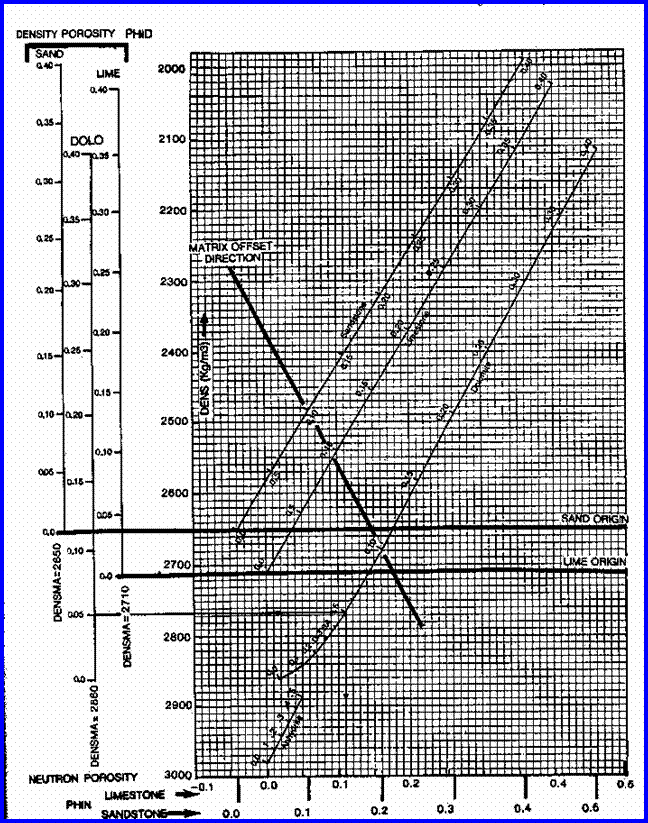
 Density Neutron Complex Lithology Crossplot - Oil and Water cases, or Gas zones with crossover.


Chartbook solutions are provided above. Shale corrected data must be entered.


COMMENTS
Use in preference to most methods if data is available, even in shaly sands to correct for heavy mineral content.


·      Do not use when density is affected by bad hole conditions.


·      No correction for log units (eg Sandstone or Limestone units) is needed for most cases, except gas in dolomite and low porosity dolomite. Use Limestone units log ONLY for these two special cases (See below).


·      Shale corrections could create apparent gas crossover and this may be real or an artifact of excessive correction. Check against known data from the well if shale correction creates crossover.


·      To calibrate to core porosity, adjust PHIDSH, PHINSH, or Vsh to obtain a better match by trial and error. Appropriate crossplots may assist, or regression of PHIxdn vs core porosity may be used.


SPECIAL CASES - GAS CORRECTIONS: 

CASE 1: IF gas is known to be present AND gas crossover occurs after shale corrections, apply the following gas correction:

 6: IF PHInc < PHIdc, there is gas crossover

 7: THEN PHIxdn = ((PHInc ^ 2 + PHIdc ^ 2) / 2) ^ 0.5


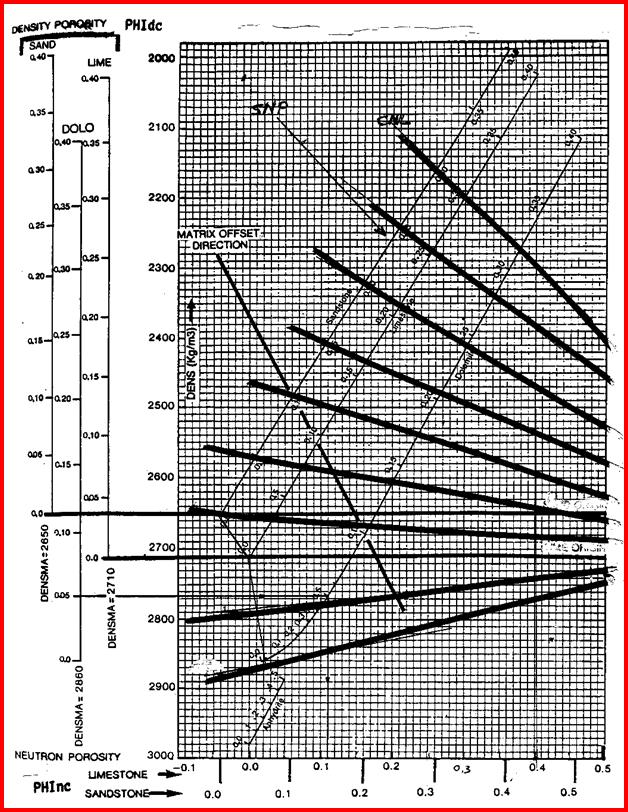
CASE 2: IF gas is known to be present but NO crossover occurs after shale corrections, this usually means gas in dolomite or in a sandstone with lots of heavy minerals. First, assume or calculate the matrix density

(DENSMAgc) based on the PE curve (PE is the only curve unaffected by gas):
      8
: V1 = (PE - Vsh * PESH - PE2) / (PE1 - PE2)
      9: V2 = 1 - V1
      10: DENSMAgc = V1 * DENS1 + V2 * DENS2

WHERE:
  DENSMAgc =  matrix density for gas correction (Kg/m3 or gm/cc)
  DENS1 = matrix density of mineral 1 (Kg/m3 or gm/cc)
  DENS2 = matrix density of mineral 2 (Kg/m3 or gm/cc)
  PE = measured PE log value of rock mixture
  PE1 = PE of first mineral (fractional)
  PE2 = PE of second mineral (fractional)
  V1 = volume of first mineral (fractional)
  V2 = volume of second mineral (fractional)
  Vsh = volume of shale (fractional)

DENSMAgc can be computed as a continuous curve or used as a zone parameter to replace DENSMA in equation 8.

Apply gas correction:

11: PHIx = – PHIdc / (PHInc / 0.8 – 1) / (1 + PHIdc / (0.8 – PHInc))

12: PHIxdn = PHIx + KD3 * (0.30 – PHIx) * (DENSMAgc / KD1 – KD2)


Where:  KD1 = 1.00 for English units

 KD1 = 1000 for Metric units

 KD2 = 2.65 for Sandstone scale log

 KD2 = 2.71 for Limestone scale log

 KD3 = 1.80 for Sandstone scale log

 KD3 = 2.00 for Limestone scale log


 Density Neutron Complex Lithology Crossplot - Gas zones with NO crossover. Enter shale corrected data and then slide data point to the right until it reaches the line representing the matrix density of the reservoir - travel parallel to the nearest heavy black line. Do not use Dolomite scale log for this special case.


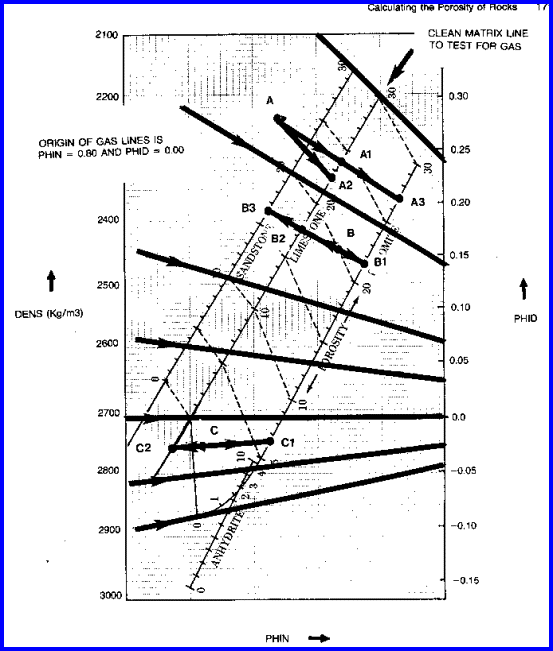
An illustration of how the points move under different conditions is given below.


Graph for Gas Correction on Density Neutron Crossplot Porosity, showing how the raw data points
 move under various assumptions. (Porosity scales are in Limestone Units)

Point A goes to A1, if CNL and DENSMA = 2710 (crossover)
               goes to A2, if SNP regardless of DENSMA
               goes to A3, if CNL and DENSMA = 2870.

Point B goes to B1, if CNL and DENSMA = 2870 and gas correction is IMPOSED
               goes to B2, if CNL and DENSMA = 27l0 and gas correction is IMPOSED
               goes to B3, if CNL and DENSMA = 2650 and gas correction is IMPOSED
               stops at B if gas correction is not imposed or if SNP

Point C goes to C1, if CNL and DENSMA = 2870 and gas correction is IMPOSED
               goes to C2, if CNL and DENSMA = 2710 and gas correction is IMPOSED
               stops at C if gas correction not imposed or if SNP

The author is indebted to Jim Hamilton of Dome Petroleum for first suggesting this approach to one pass gas corrections. The approach has proved extremely successful and has matched core on hundreds of projects in many reservoir conditions.

Before the introduction of the photo-electric effect (PE) log curve, it was easy for a log analyst to miss a gas filled dolomite reservoir. The standard density neutron crossplot would show a low porosity limestone, when in fact the zone is a medium porosity dolomite. Since the density neutron looks like limestone (curve separation is small) and the PE looks like dolomite (PE near 3.0), this discrepancy is a red flag that a special case exists. Many computer programs will not trigger gas corrections unless density neutron crossover is present, and most programs do not contain explicit algorithms to handle this special case.

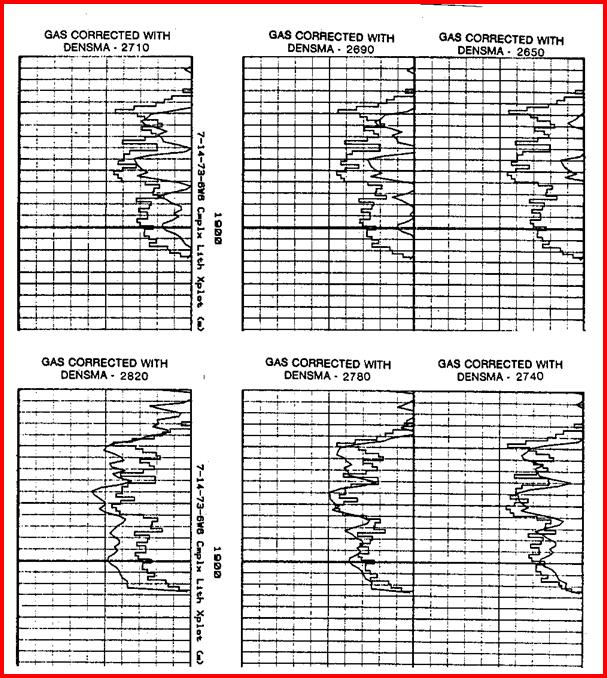
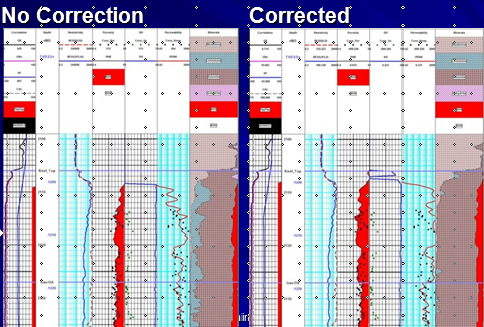
The illustration below  shows the effect of using this gas correction. Notice that computed porosity does not match core porosity unless the correct DENSMA is chosen. DENSMA should reflect the matrix density of the expected lithology. The correction is usually needed in dolomite or dolomitic sands or high porosity shaly sands with low to moderate invasion.


Effect of DENSMA on density neutron crossplot porosity with gas in heavy minerals. Core porosity (square black lines) and log analysis porosity (smooth black curves) show a good match when DENSMA was set at
2710 - 2740 Kg/m3. Log analysis shows near zero porosity if DENSMA set at 2650 for this heavy sandstone.


SPECIAL CASES - LOW POROSITY and SECONDARY POROSITY:
CASE 3: IF rock is dolomite AND porosity is less than 0.05, use the following instead of Equation 4:

 13: E = (4 - (3.3 + 10 ^ (-5 * PHInc - 0.16))

 14: PHIxdn = (E * PHIdc + 0.754 * PHInc) / (E + 0.754)


Log data must be in Limestone Units for this Case. This option can be used instead of equation 4 as long as there is no gas crossover after shale corrections. It is slightly more accurate, but requires a computer or preprogrammed calculator. Some more modern CNL logs use alternate porosity transforms and are more linear at low porosities, so this fix may not be needed (rg. TNPH curve).


CASE 4: IF Archie or dual water model is to be used for water saturation, the following is needed:

 15: BVWSH = (PHIDSH + PHINSH) / 2     (a constant for the zone)

 16: PHIt = (PHID + PHIN) / 2                      (one value for each layer)


CASE 5: IF zone is vuggy carbonate, calculate secondary porosity:

 17: PHIsec = PHIxdn - PHIsc


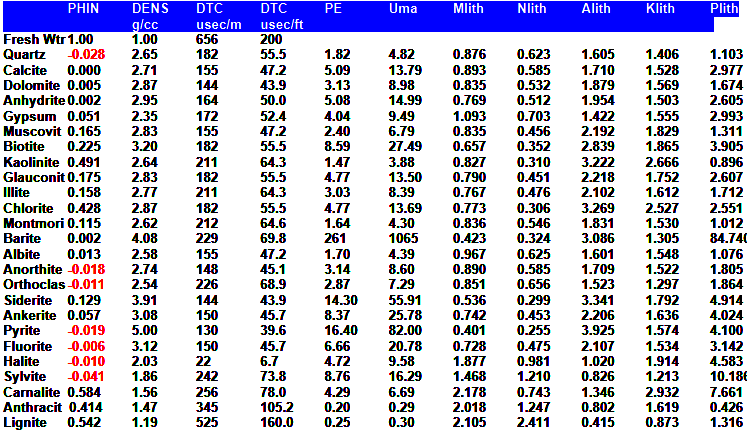
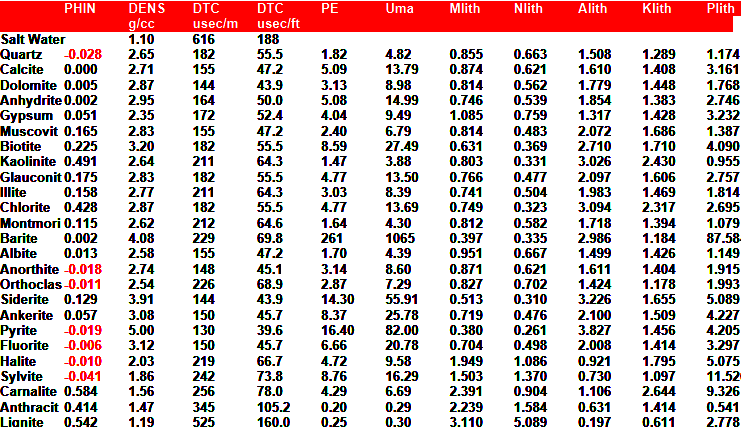
Density LOG PARAMETERS 
 

	PHIN	DENS	DTC	DTC	PE	Uma	Mlith	Nlith	Alith	Klith	Plith   
		g/cc	usec/m	usec/ft						  	          
Salt Wtr	1.050	1.10	616	188							
Fresh Wtr	1.000	1.00	656	200							
Quartz    	-0.028	2.65	182	55.5	1.82	4.82	0.876	0.623	1.605	1.406	1.103
Calcite	0.000	2.71	155	47.2	5.09	13.79	0.893	0.585	1.710	1.528	2.977
Dolomite	0.005	2.87	144	43.9	3.13	8.98	0.835	0.532	1.879	1.569	1.674
Anhydrite	0.002	2.95	164	50.0	5.08	14.99	0.769	0.512	1.954	1.503	2.605
Gypsum	0.051	2.35	172	52.4	4.04	9.49	1.093	0.703	1.422	1.555	2.993
Muscovite	0.165	2.83	155	47.2	2.40	6.79	0.835	0.456	2.192	1.829	1.311
Biotite	0.225	3.20	182	55.5	8.59	27.49	0.657	0.352	2.839	1.865	3.905
Kaolinite	0.491	2.64	211	64.3	1.47	3.88	0.827	0.310	3.222	2.666	0.896
Glauconit	0.175	2.83	182	55.5	4.77	13.50	0.790	0.451	2.218	1.752	2.607
Illite	0.158	2.77	211	64.3	3.03	8.39	0.767	0.476	2.102	1.612	1.712
Chlorite	0.428	2.87	182	55.5	4.77	13.69	0.773	0.306	3.269	2.527	2.551
Montmori	0.115	2.62	212	64.6	1.64	4.30	0.836	0.546	1.831	1.530	1.012
Barite      	0.002	4.08	229	69.8	 261	1065	0.423	0.324	3.086	1.305	84.74
Albite	0.013	2.58	155	47.2	1.70	4.39	0.967	0.625	1.601	1.548	1.076
Anorthite	-0.018	2.74	148	45.1	3.14	8.60	0.890	0.585	1.709	1.522	1.805
Orthoclas	-0.011	2.54	226	68.9	2.87	7.29	0.851	0.656	1.523	1.297	1.864
Siderite	0.129	3.91	144	43.9	14.30	55.91	0.536	0.299	3.341	1.792	4.914
Ankerite	0.057	3.08	150	45.7	8.37	25.78	0.742	0.453	2.206	1.636	4.024
Pyrite	-0.019	5.00	130	39.6	16.40	82.00	0.401	0.255	3.925	1.574	4.100
Fluorite	-0.006	3.12	150	45.7	6.66	20.78	0.728	0.475	2.107	1.534	3.142
Halite	-0.010	2.03	219	66.7	4.72	9.58	1.877	0.981	1.020	1.914	4.583
Sylvite     	-0.041	1.86	242	73.8	8.76	16.29	1.468	1.210	0.826	1.213	10.18
Carnalite	0.584	1.56	256	78.0	4.29	6.69	2.178	0.743	1.346	2.932	7.661
Anthracit  0.414	1.47	345	105.2	0.20	0.29	2.018	1.247	0.802	1.619	0.426
Lignite	0.542	1.19	525	160.0	0.25	0.30	2.105	2.411	0.415	0.873	1.316

* Multiply DENS (g/cc) by 1000 to get Kg/m3 where needed


Copyright © E. R. (Ross) Crain, P.Eng.  email
Read the Fine Print