|
 Crain's Usage Rules For Porosity MethodS
The answers for all the porosity solutions will vary, and in some
cases be unreasonable or impossible to calculate due to lack of
data. In order of preference, we would choose:
BEST MODELS -- Use whenever possible
1. Shale Corrected Density Neutron Complex Lithology Crossplot
Model aka "Complex Lith".
Preferred because equations are simple, requires no
assumptions, is unaffected by mineral mixtures, gas
correction is easy.
The Meta/Kwik
spreadsheet for this model is available at
Downloads and
Spreadsheets.
2. NMR Porosity Model
Negligible effect from minerals or shale. Limited use in
very rough boreholes.
OTHER CROSSPLOT MODELS --- Use only within
limitations noted on eqch page.
3. Sonic Neutron Crossplot
Limitations: OK in carbonates or in bad hole where
density is not acceptable, must be shale corrected in shaly
sands.
4. Sonic Density Crossplot
Limitations: gas
correction difficult, not as accurate as complex lith.
5. Density Neutron Shaly Sand Crossplot Models
Limitations: only for shaly quartz/feldspar sands, matrix
offset model needed if other minerals present, complex lith
model is easier.
6. Density Neutron Bulk Volume
Water Crossplot Models
Limitations: only for shaly quartz/feldspar sands, matrix
offset model needed if other minerals present, complex lith
model is easier. Also needs dry clay properties.
SINGLE LOG MODELS -- Use only if no
crossplot method is possible
7. Sonic Log Corrected for Shale
Limitations: VERY sensitive to mineral, gas, compaction, and
shale parameter assumptions.
8. Neutron Log Corrected for Shale
Limitations: VERY sensitive to gas and shale parameter
assumptions.
9. Density Log Corrected for Shale
Limitations: works in good borehole only,
VERY sensitive to mineral and gas parameter assumptions.
10. Microresistivity, shallow or deep resistivity
Very sensitive to mud properties and invasion profike.
Microlog sensitive to borehole breakout.
Use in ancient wells that have no porosity logs.
11. Maximun Porosity Model
Use as last resort in sand shale sequences. DO NOT use in
carbonates.
12. Non-Porosity Triggers
Use if needed in anhydrite, coal, gypsum, salt, etc
NOTE:
Apply Porosity Trimming constraints to
selected method.

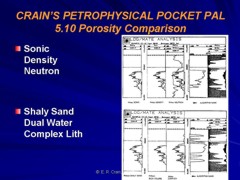
Computed Results for Mixed Lithology Example from six
different porosity models, compared
to core analysis porosity.
All porosity calculations need to be
calibrated to core data at some point, usually at an early stage in
an analysis project. Log analysis in isolation from other data is
pointless and dangerous.
Trimming POROSITY
results
Material balance for porosity is needed to prevent too high a
porosity in very shaly sections or in bad hole conditions.
Negative values must also be trimmed off to prevent errors in
further steps in the calculation sequence..
1: IF PHIe < 0
2: THEN PHIe = 0
3: IF PHIe > PHIMAX * (1.00 - Vsh)
4: THEN PHIe = PHIMAX * (1.00 - Vsh)
Where:
PHIe = porosity from any method (fractional)
Vsh = shale content from any method (fractional)
PHIMAX = maximum expected porosity in clean rock (fractional)
Don't fail to use this routine. It makes computer output look
pretty nice even with poor logs.
RECOMMENDED PARAMETERS:
Normal values for PHIMAX:
Very high porosity sandstone (and tar sands) PHIMAX = 0.36 to
0.42
High to medium porosity PHIMAX = 0.25 to 0.36
Low or shaly medium porosity PHIMAX = 0.18 to 0.25
Very low porosity, PHIMAX = 0.10 to 0.18
Normally you will settle upon a method that suits you and the
zone under consideration. You will not have time to compute results
from all methods. Use the above list as a guide to reduce your
effort and to gain a better chance for success on the first pass.
Log analysis is seldom satisfactory on the first pass in new areas,
so do not be bashful about trying several methods.
Then keep a record of which methods worked best in which areas.
|