|
 Sonic Neutron Crossplot
The sonic neutron crossplot model is used to estimate porosity
when the density neutron crossplot method cannot be used,
due to lack of density log or bad density data caused by
rough hole conditions.. The sonic neutron crossplot method
works well when shale volume, matrix rock properties, and
sonic compaction effects are
accurately known. If both density and neutron logs are available, a superior
model that does not require matrix rock properties is the
Shale Corrected Density Neutron
Complex Lithology Crossplot Method. The Meta/Kwik
spreadsheet for this model is available at
Downloads and Spreadsheets.
The sonic neutron crossplot method involves the simultaneous solution
of the sonic and neutron response equations for porosity. They
are similar in form to the density neutron pair, and will not
be repeated here.
Since both logs
respond similarly to shale, the formulae do not have much accuracy
in very shaly sands.
Gas effect is similar to the density neutron crossplot, so gas
may be corrected for.
Sonic Neutron CrossplOT
POROSITY
Calculate
compaction correction for sonic.
For Metric units (usec/m)
1A: KCP = max (1, DTCSH / 328
OR For English units (usec/ft)
1B: KCP = max (1, DTCSH / 100
Calculate sonic porosity.
2: PHIS = (DTC - DTCMA) / (DTCW - DTCMA) / KCP
Calculate shale corrected sonic porosity:
3: PHISSH = (DTCSH - DTCMA) / (DTCW - DTCMA) / KCP
4: PHIsc = PHIS - Vsh * PHISSH
Calculate shale corrected neutron porosity:
5: PHInc = PHIN - Vsh * PHINSH
Check for gas crossover using PHInc and PHIsc.
If no gas crossover, that is
6: IF PHInc >= PHIsc
7: THEN E = 0.5 - 10 ^ (-5 PHInc - 0.3)
8: AND G = -0.146
9: AND PHIxsn = (G * PHInc - E * PHIsc) / (G - E)
If gas crossover occurs, that is:
10: IF PHInc < PHIsc
11: THEN PHIxsn = ((PHIsc ^ 2 + PHInc ^ 2) / 2) ^ 0.5
Where:
DTCSH = sonic log shale value for compaction correction (usec/ft
or usec/m)
KCP = compaction factor (fractional)
DTC = sonic log reading (usec/ft or usec/m)
DTCMA = travel time in rock matrix (usec/ft or usec/m)
DTCSH = sonic log reading in shale (usec/ft or usec/m)
DTCW = travel time in water (usec/ft or usec/m)
E = neutron pseudo matrix point
G = sonic pseudo matrix point
PHIN = neutron log reading (fractional)
PHINSH = neutron log reading in shale (fractional)
PHInc = porosity from neutron log corrected for shale (fractional)
PHIS = porosity from sonic log (fractional)
PHIsc = porosity from sonic corrected for shale (fractional)
PHISSH = sonic porosity in shale (fractional)
PHIxsn = porosity from sonic neutron crossplot (fractional)
Vsh = shale volume (fractional)
COMMENTS:
The overall layout of the neutron sonic crossplot is shown
below.
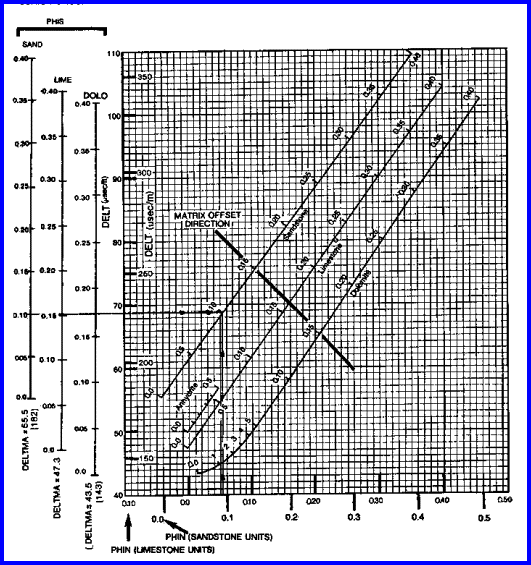
Chart for Sonic Neutron Porosity Model - shale corrected data
must be entered
The gas correction represents a 45 degree line (in porosity units)
on the crossplot. The method is best used in carbonates with or
without gas, and is inappropriate for shaly sand.
Thismethod is especially useful in cased holes where a shear sonic and
neutron log can be run through casing.
NUMERICAL
EXAMPLE:
1. Assume data for Sand "D".
DTC = 300 usec/m
PHIN = 0.28
KCP = 1.00
DTCSH = 328 usec/m
PHINSH = 0.30
Vsh = 0.33
DTCMA = 182 usec/m
DTCW = 616 usec/m
no matrix offset
PHIS = (300 - 182) / (616 - 182) / 1.0 = 0.27
PHISSH = (328 - 182) / (616 - 182) / 1.0 = 0.33
PHIsc = 0.27 - 0.33 * 0.33 = 0.16
PHInc = 0.28 - 0.33 * 0.30 = 0.18
E = -0.5 - 10 ^ (0-5 * 0.18 - 0.3) = 0.43
G = -0.146
PHIxsn = (-0.146 * 0.18 - 0.43 * 0.16) / (-0.146 - 0.54) = 0.165
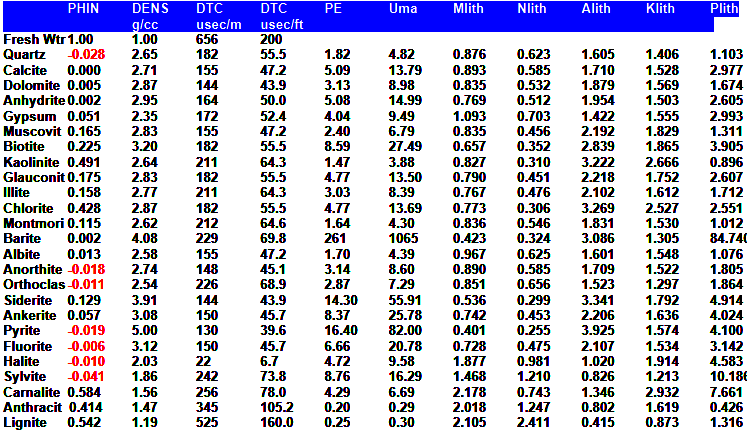
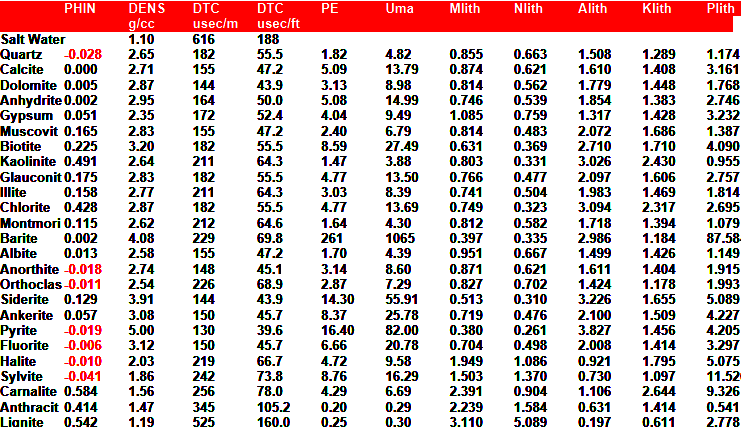
MATRIX ROCK PROPERTIES
|