|
 Lithology from Matrix
TRAVEL TIME
Lithology from Matrix
TRAVEL TIME
"Slowness" is the new word for sonic or acoustic travel
time. The inverse of slowness is speediness or velocity. We
continue to use travel time in this Handbook - it's hard to
teach old dogs new tricks.
The
apparent matrix travel time can be calculated in a similar fashion
to the matrix density, again by rearrangement of the response
equation.
Calculate Matrix Travel
Time:
1: IF Vsh + PHIe < 0.95
2: THEN DTCma = (DTC - PHIe * DTCW - Vsh *
DTCSH) / (1 - PHIe - Vsh)
3: OTHERWISE DTCma = DTC
Calculate mineral volumes (relative to each other)
4: Vmin1 = (DTCma - DTC2) / (DTC1 - DTC2)
5: Vmin2 = 1.00 - Vmin1
Calculate mineral volumes (relative to total rock volume)
6: Vrock = (1.0 - Vsh - PHIe)
7: V1 = Vmin1 * Vrock
8: V2 = Vmin2 * Vrock
Where:
DTC = sonic log reading (usec/ft or usec/m)
DTCma = computed matrix travel time (usec/ft or usec/m)
DTC1 = matrix travel time for first mineral (usec/ft or usec/m)
DTC2 = matrix travel time for second mineral (usec/ft or usec/m)
DTCSH = sonic log reading in shale (usec/ft or usec/m)
DTCW = sonic log reading in water (usec/ft or usec/m)
PHIe = effective porosity from any method (fractional)
Vsh = volume of shale (fractional)
Vrock = rock volume (fractional)
Vmin1 = volume of first mineral (fractional)
Vmin2 = volume of second mineral (fractional)
Volumes for lithology track
V1 = volume of first mineral (fractional)
V2 = volume of second mineral (fractional)
COMMENTS:
This
equation breaks down with high values of PHIe + Vsh, so we set
DELTma = DELT when PHIe + Vsh > 0.95.
This
model is not very sensitive in carbonates - the matrix density model
is better, if data is available.
The
matrix travel time can be obtained graphically from the chart below.

Sonic neutron crossplot to find DELTma
NUMERICAL
EXAMPLE:
1. Assume
Sand D in Example 1.
DTC = 300 usec/m
DTCSH = 328 usec/m
Vsh = 0.33
DTCW = 616 usec/m
PHIe = 0.11
DTCma = (300 - 0.11 * 616 - 0.33 * 328) / (1 - 0.11 - 0.33) = 229
usec/m
This
value falls in the impossible area and is too high because the sonic
log reads high compared to effective porosity found from the density
neutron crossplot. If porosity was 0.16, the matrix travel time
would be 183 usec/ft (close to the sandstone value).
This
is another quality control indicator, and in this example
demonstrates a lack of coherence between the sonic and density
neutron data, when the matrix, shale and fluid assumption are as
given above. Either these parameters, or the log data, or the whole
rock model are in error.
Sonic Lithology Codes
Lithology codes are more difficult to generate with sonic data then
with density data.
SlithCode - Sonic Lithology Codes
|
DELTma |
|
|
|
English |
Metric |
SlithCode |
|
usec/ft |
usec/m |
|
|
< 41 |
< 134 -- |
---- |
|
41 - 45 |
134 - 147 |
DOLO |
|
45 - 49 |
147 - 160 |
LIME |
|
49 - 51 |
160 - 167 |
ANHY |
|
51 - 58 |
167 - 190 |
QRTZ |
|
58 - 65 |
190 - 213 |
---- |
|
65 - 68 |
213 - 223 |
SALT |
|
68 - 72 |
223 - 236 |
---- |
|
72 - 76 |
236 - 249 |
SYLV |
|
76 - 80 |
249 - 262 |
CARN |
|
80 - 120 |
262 - 393 |
COAL
(only if trigger set) |
|
120 - 124 |
393 - 406 |
SULF |
|
> 124 |
> 406 - |
---- |
|
if Vsh >
0.85 |
|
SHLE |
COMMENTS:
The bad
hole code does not intervene in sonic calculations.
Should
not be used in shallow unconsolidated sandstones.
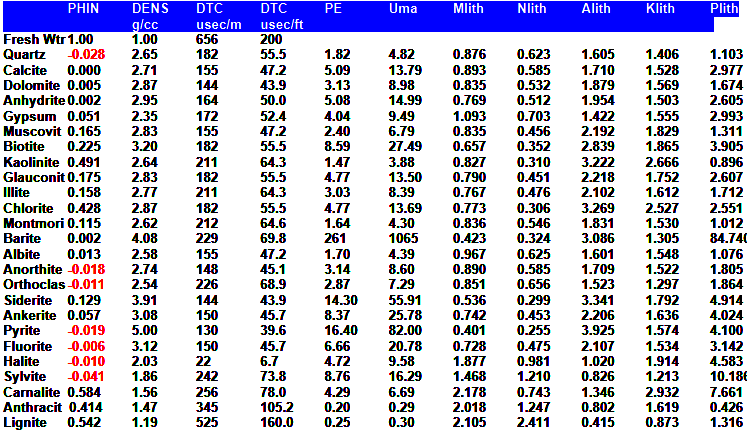
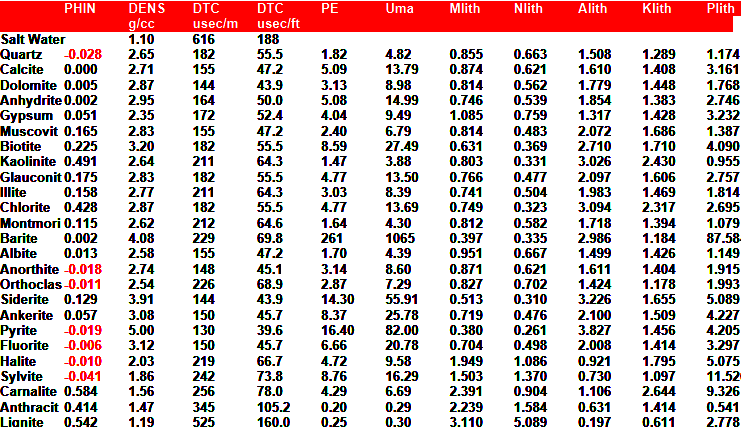
SONIC PARAMETERS
|