These rules are the basic set for segregating shales from other rock types. Pure shales are seldom zones of interest as oil and gas reservoirs, although many rocks that have been traditionally called "shales" are really silty or sandy shales. These are now zones of interest as "shale gas" reservoirs. Pure shales may be hydrocarbon source rocks and are interesting in different ways than reservoir rocks.
Crain’s Rule #0:
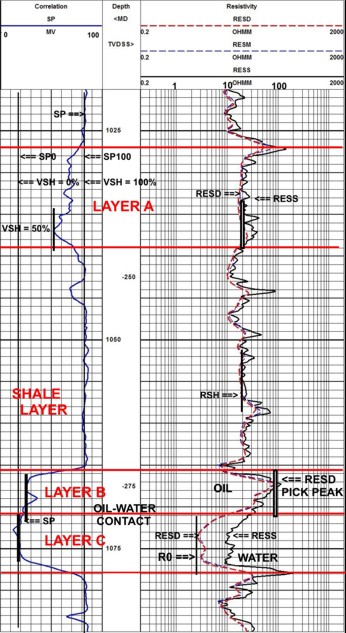
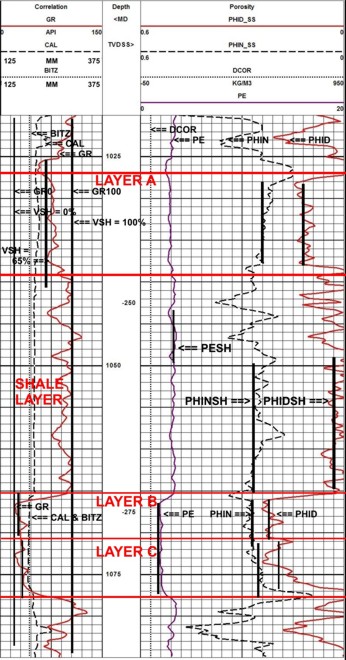
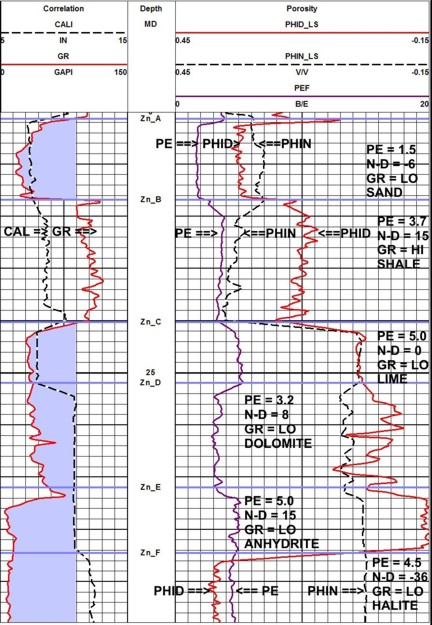
Shale beds are not “Zones of Interest”. Everything else, including very shaly sands (Vsh < 0.75) are interesting. Although a zone may be water bearing, it is still a useful source of log analysis information, and is still a zone of interest at this stage. Clean and shaly sands have been marked on the logs shown below (Layers A, B, and C). Everything else are shale beds.
To find clean zones versus shale zones, examine the spontaneous potential (SP) response, gamma ray (GR) response, and density neutron separation. Low values of GR, highly negative values of SP, or density neutron curves falling close to each other usually indicate low shale volume. High GR values, no SP deflection, or large separation on density neutron curves normally indicate high shale volume. Young shales have low resistivity (1 to 4 ohm-m), older shales have medium resistivity (5 to 25 ohm-m). Shale source rocks have higher resistivity (25 to 250 ohm-m) and usually have extra high GR (150 to 300 API units).
These rules are intended to segregate clean rocks into various common minerals, typically quartz, calcite, dolomite, anhydrite, and halite. These are by far the most common minerals in sedimentary rocks. If you prefer rock names, the rules will distinguish sandstone, limestone, dolostone, anhydrite, and rock salt - same stuff, alternate names.
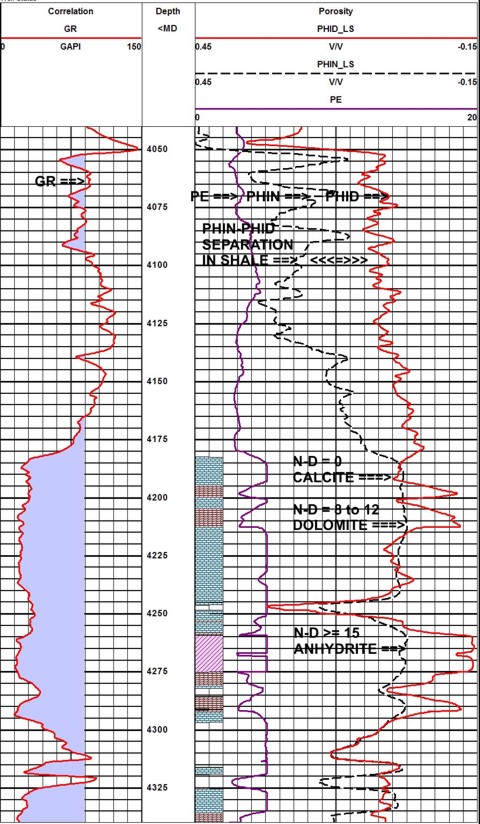
On Sandstone Units logs, separation for sandstone is near zero, limestone is about 7 porosity units, dolomite is 15 or more, and anhydrite is 22 or more.
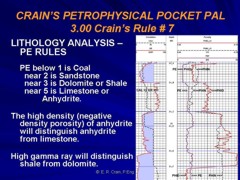
Visual determination of lithology (in addition to identifying shale as discussed earlier) is done by noting the quantity of density neutron separation and/or by noting absolute values of the photo electric curve. The rules take a little memory work.
You must know whether the density neutron log is recorded on Sandstone, Limestone, or Dolomite porosity scales, before you apply Crain’s Rule #6. The porosity scale on the log is a function of choices made at the time of logging and have nothing to do with the rocks being logged. Ideally, sand-shale sequences are logged on Sandstone scales and carbonate sequences on Limestone scales. The real world is far from ideal, so you could find any porosity scale in any rock sequence. Take care!
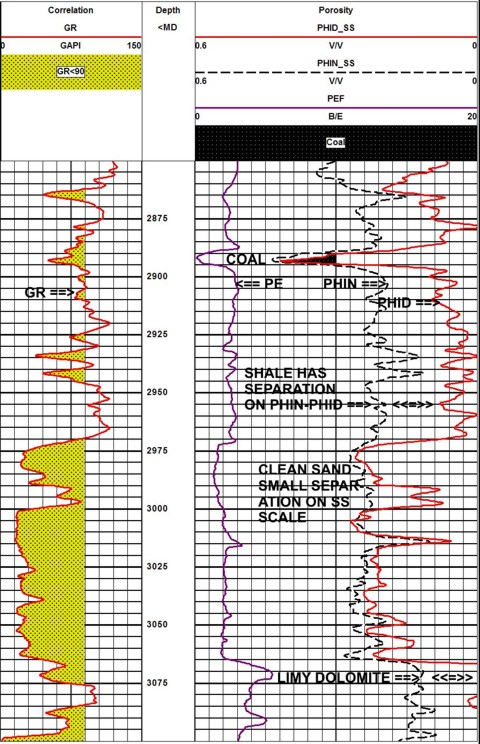
Sand – shale identification from gamma ray and density-neutron separation. Small amounts of density neutron separation with a low gamma ray may indicate some heavy minerals in a sandstone. Most minerals are heavier than quartz, so any cementing materials, volcanic rock fragments, or mica will cause some separation. Both pure quartz (no separation) and quartz with heavy minerals (some separation) are seen here.
The photoelectric effect is often a direct mineralogy indicator..
ROCK
N–D N–D PE GR SAND 0 - 7 2 LO LIME 7 0 5 LO DOLO 15+ 8+ 3 LO ANHY 22+ 15+ 5 LO SALT - 37 - 45 4.5 LO
SHLE 20+ 13+ 3.5 HI
THINK
LIKE A DETECTIVE:
Remember: logs are not perfect and these rules are not perfect. Adjust the rules to suit your experience. Mineral mixtures are common, so think in terms of what is possible in each case.
On the
log at the right, the evidence and conclusion is shown for 6
layers with different lithology.
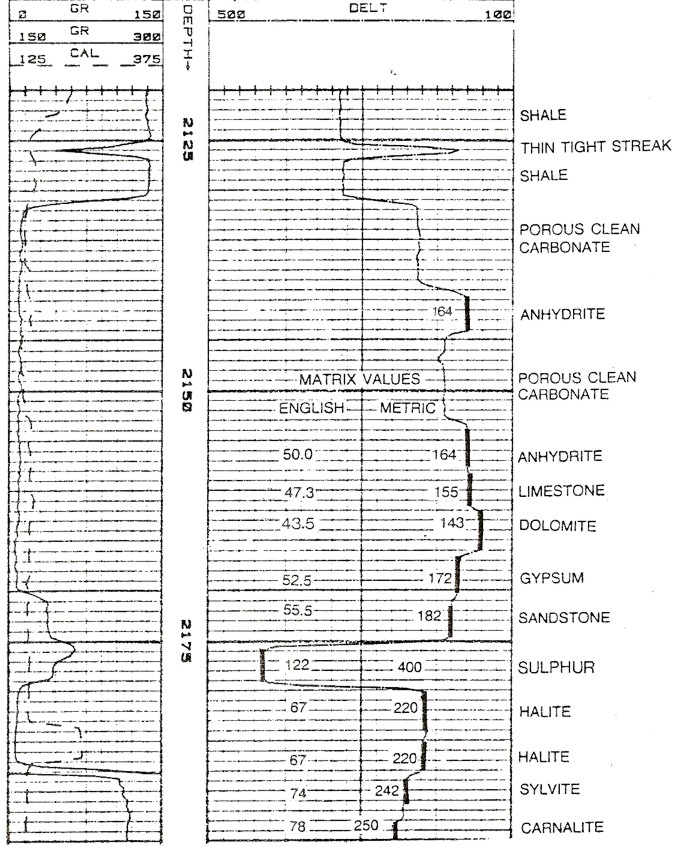
 SONIC DENSITY NEUTRON GR RULES
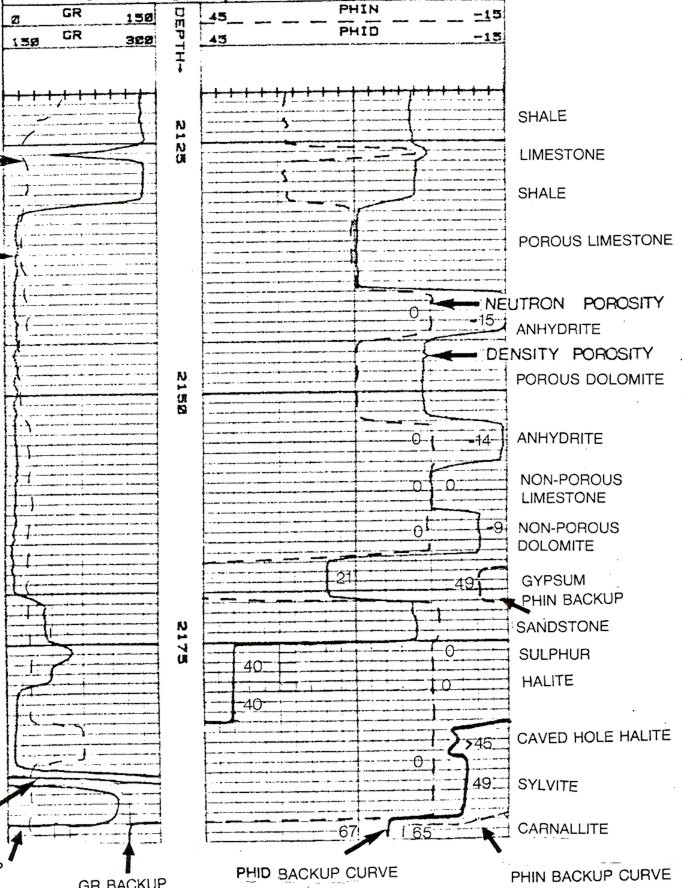
A combination of neutron density separation rules, plus some "absolute value" rules can be used to identify evaporite minerals. An example is shown below, in which the absolute values for some pure minerals are shown. Some mineral mixtures may be identified by intermediate absolute values plus some local knowledge.
Absolute values of neutron and density porosity for some pure minerals - these are particularly useful for evaporite minerals. Note the backup scales that are needed pr density, neutron, and GR curves that are required to handle some of these minerals
Clean Quartz –
0.028 2650 182 0.802
0.623 1.82 4.8
|
|
||
|
Page Views ---- Since 01 Jan 2015
Copyright 2023 by Accessible Petrophysics Ltd. CPH Logo, "CPH", "CPH Gold Member", "CPH Platinum Member", "Crain's Rules", "Meta/Log", "Computer-Ready-Math", "Petro/Fusion Scripts" are Trademarks of the Author |
|||


|
||
| Site Navigation | MINERALOGY CRAIN'S RULES FOR VISUAL ANALYSIS | Quick Links |