|
Please be fair to the author. Pay your Shareware fee HERE, and receive the CD-ROM at no extra cost. |
|
CALIBRATING WATER SATURATION
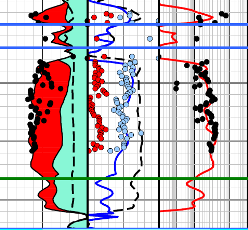
The minimum water saturation for a given core plug is taken from the graph (or associated data listing) at the height above free water that is appropriate for the well in question. Notice that each cap pressure curve has an associated porosity and permeability value. Low permeability and low porosity rocks have high water saturation. In fact, it is possible for a rock to be 100% wet in the middle of an oil zone merely because the porosity is too low for oil to get into the pores. No water will be produced from these intervals because the irreducible water saturation is also 100%. The cap pressure curve at top right represents such a rock - it would have to be 180 feet above free water before it could take on even 1% oil saturation. Any similar rock closer to the water zone would be 100% wet, but adjacent layers in the same reservoir could have better rock properties (higher porosity, lower water saturation) and therefore lower water saturation. The best way to see the relationship is to crossplot porosity vs cap pressure water saturation at some arbitrary height above free water. If a reservoir is very thick, make several crossplots at different heights. Make similar plots for the computed log analysis results and compare them to the cap pressure crossplots. Data sets must be segregated by rock type or pore geometry to be meaningful. A typical plot for a sandstone in which porosity varies with shaliness is shown below. Notice that the data follows a good hyperbolic trend in the higher porosity and trails downward to a lower hyperbola as porosity decreases, indicating a different rock type or pore geometry. The data at extreme right with high porosity is from the water zone.
An overlay of cap pressure derived data (not shown) would confirm or refute the log results. First, be sure the two data sets are from similar rock types and that only one rock type is represented on each graph. If the trend lines defined by the hyperbolas are different, you must revise the log analysis (or discount the cap pressure data as "not representative"). This may involve changing any or all of the following: Vsh, PHIe, RW, A, M, N, temperature, gas correction logic, or the saturation model. Clearly there is no unique solution and an "eyeball" best fit is all you can expect. Some analysts have tried to create depth plots of cap press water saturation based on porosity and height above free water to compare with log analysis results. This is a very difficult and seldom proves very much. The crossplot approach is a more statistical view and easier to defend. Water and oil saturation on conventional core analysis has little quantitative meaning when the core was drilled with water based mud. Invasion of drilling fluid makes a core look a lot like the invaded zone, and flushing of oil can be more or less complete. Bleeding oil in a core is not usually a good sign; if the zone was any good, the moveable oil should have been moved. A change from little or no residual oil to more might indicate a gas-oil contact; from some to none may indicate an oil-water contact. The amount of residual oil can sometimes be correlated to original oil saturation. Oil saturation in a core drilled with oil based mud may be close to original oil saturation, but some oil mud systems do invade the, giving a false impression of good oil saturation. Sample descriptions and mud logs will indicate the presence of oil or gas at certain depths in a well. This data cannot help in quantitative calibration, but is useful in targeting zones for further study.
|
|
Copyright ©
E. R. (Ross) Crain, P.Eng.
email |