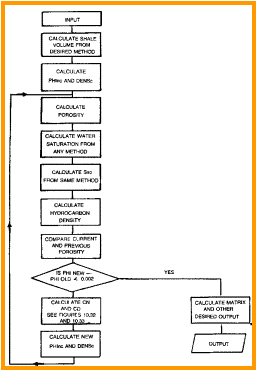
1. Apply environmental corrections to raw log data. 2. Calculate shale volume from any appropriate method. 3. Calculate porosity from any appropriate method. 4. Calculate invaded zone and un-invaded zone water saturations. 5. Calculate hydrocarbon and apparent fluid density. 6.
Calculate correction to density and neutron logs, if fluid density
is less than 0.8 gm/cc 800 kg/m3
8. Re-compute shale volume if selected method used density or neutron log data, using the new density and neutron values. 9. Re-compute porosity if selected method used density or neutron log data, using the new density, neutron and new shale volume. 10. Re-compute saturation using the new porosity and shale volume. 11. Compare new porosity with previous value. 12. If there is little change, then go to step 13, otherwise repeat steps 5 through 12. 13. Calculate other results desired with the final shale, porosity and saturation values. This process is indicated in the flow diagram at right, Since other parameters may be in error, particularly shale and matrix assumptions, the iteration may not converge, so a trap must be put in the program to exit after some reasonable number of iterations defined by the user. Even if it does converge, the result may still suffer from poor data or poor assumptions. Due to gas effect on sonic data, iteration could improve results from this method provided some relationship could be quantified between Sxo and the fluid travel time. This relationship is not well known and is not likely to be helpful at the present time.
The steps taken are as follows: 1. Apply environmental corrections to raw log data. 2. Calculate shale volume from any appropriate method. 3. Calculate porosity from any appropriate method. 4. Calculate invaded zone and un-invaded zone water saturations. 5. Calculate lithology and mineral fractions (see Chapter Nine) 6. Calculate theoretical log response based on above answers from appropriate log response equations. 7. Compare calculated response with actual logs and calculate error statistics. 8. Sum these errors and compare to previous iterations. 9. If error is minimum go to Step 11 10. If error is not minimum, adjust analysis parameters and analysis model and repeat Steps 2 through 10. 11. Calculate other results desired with the final shale, porosity and saturation values. If
this method is used in an interactive program, the analyst can
be involved in the decision process of Step 10. If the computer
program contains the decision making logic, it works best when
the analyst has described the best model, and may fail to give
reasonable results when an inappropriate model has been presented. |
|
||
|
Page Views ---- Since 01 Jan 2015
Copyright 2023 by Accessible Petrophysics Ltd. CPH Logo, "CPH", "CPH Gold Member", "CPH Platinum Member", "Crain's Rules", "Meta/Log", "Computer-Ready-Math", "Petro/Fusion Scripts" are Trademarks of the Author |
|||


|
||
| Site Navigation | WATER SATURATION ITERATIVE and STATISTICAL MODELS | Quick Links |
 Iterative and Error Minimization
Solutions
Iterative and Error Minimization
Solutions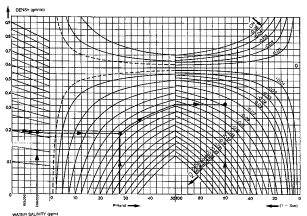
 7.
Add these corrections to the previous density and neutron log
data.
7.
Add these corrections to the previous density and neutron log
data. I
I