CASE HISTORY -- RADIOACTIVE SAND
Radioactive Sands --Granite Wash - Bald
High Uranium-Ricj
Sands
Granite Reservoirs

RADIOACTIVE SANDS
Radioactive sands are often
mistaken for shale Radioactivity can come from uranium
or feldspar. Weathering of granite can produce porosity and
normal migration paths may bring oil to the porous
reservoir. There are very large granite reservoirs offshore
Viet Nam and smaller ones in many other countries, including
the USA. These reservoirs are often called "bald
highs".
If weathered granite is moved by normal erosional
processes, the resulting reservoir is often called a
"granite wash".
Most real reservoirs exhibit more
than one problem to be solved by the analyst. Here we have a sand
that is radioactive because it is a feldspar sand. Feldspar contains
potassium which is radioactive, so the zone looks like a shale on
the gamma ray log. The density neutron porosity curves on sandstone
scale however show zero separation, so
this interval cannot be a
shale. If you think like a detective, the answers usually come to
light; gather the evidence, assess the evidence, discard the
impossible, select the most probable from what remains. In general,
the simplest solution is often the best choice.
Composite raw
data plot for radioactive feldspar sand.
This example has no gamma ray
spectral log. It would have been a help, but is not essential since we know
the area and the density neutron curves answer all the
questions about porosity and lithology.
There is a second issue though,
and that is the low resistivity over most of the sand interval.
suggesting a water zone. The highest resistivities are in tight
anhydrite and dolomite. The best resistivity in the sand is just 2
ohm-m and the water zone is 0.4 ohm-m, a contrast of 5:1. An old
rule of thumb suggests that a ratio of 3:1 or better means we should
complete the well, as long as the porosity is about the same in both
the water and oil legs.
A test on the top of the sand in
the well on the left, below, produced clean oil, but water cut
increased after about six months production. A second well at the
right was drilled and tested water with some oil. The resistivity
log signature is only very slightly different than the first well.
Visually there is not much difference between them.
Detailed
petrophysical analysis does show subtle differences. The well on the
left shows a 2 meter pay zone on either a long transition zone or a
depleted oil zone of about 7 meters. The second well shows only a
half meter of pay on top of the same transition zone. The test and
production results are confirmed by the fluid distribution in the
two wells. And there is not much that can be done to improve the oil
production.

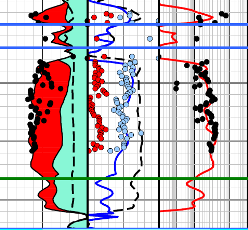
Actual saturation (blue curve in
Track 3) compared to irreducible water saturation (black curve) in
two wells. Where the two curves are close together, little water
will be produced at initial completion. Where they are separated,
water will flow with the oil. Production histories on these two
wells bear out this interpretation: the well on the left produced
clean oil for six months, the other tested water with oil
immediately.
A
good wellsite geologist will correlate his description to the
shape of the drilling time log. Later, the sample depths may be
adjusted to the open hole logs, especially gamma ray, resistivity,
and density logs. In this pair of wells, the first hint of the
feldspar sands is in the wellsite sample descriptions as shown
below.

Log analysis lithology plot (left) in a complex sequence, and sample
description plot (right) over the same interval.
Although the lithology description is not usually quantitative,
it is an essential ingredient in choosing the correct mineral
mixture for the log analysis lithology calculation. A little
care is needed to read these logs. In this case, the word "SAND"
describes the rock texture, not its mineralogy. This is a
radioactive sand so it must contain feldspar (decomposed
granite) and possibly some quartz, as well as the dolomite and
anhydrite layers above the sand. Shale, of course must be
handled by an appropriate method. In this case, shale cannot be
found using the GR inside the radioactive sand interval.
|