Return To Handbook IndexRoss Crain's Resume
W
ELCOME  TO
CRAIN'S PETROPHYSICAL HANDBOOK

 Please be fair to the author. Pay your Shareware fee HERE, and receive the CD-ROM at no extra cost.

CASE HISTORY -- TIGHT OIL RESERVOIRS

     Tight Oil Basics     Geology     Shale Volume     Porosity     Water Saturation     Permeability
                      Lithology       Pyrite Corrections      Using Cap Pressure Data       Bakken Examples   

TIGHT OIL BASICS
Most of us are familiar with tight gas reservoirs – clean, low porosity sandstones or siltstones that look unattractive on log analysis, at least by the conventional wisdom of the 1960’s. By the end of the 1970’s, we had overcome these hang-ups and exploitation in tight sands developed rapidly, along with the fracturing technology needed to make them economic.

Further progress in drilling and fracturing of horizontal wells brought us to shale gas, although most such plays are not really shales, but low porosity siltstones or laminated shaly sands. Many are radioactive due to uranium and look like shale on logs, hence the continued reference to “shale”.

Siltstones are a mixture of quartz and other minerals, predominately dolomite and calcite, but many others may be present. They are characterized by low permeability, usually less than 1 milli-darcy. When filled with gas, we think of these as “tight gas” reservoirs. A conventional complex lithology log analysis model is used and such reservoirs are not considered “unconventional”.

When shale volume increases, these reservoirs become shaly silts or silty shales; they may have sufficient organic content to become gas shales with adsorbed gas. Then we use the shale gas model described earlier.

The same revolution is occurring in oil exploration. Tight oil or “shale oil” is the current hot topic. Again, most such plays are siltstones or mudstones without a lot of clay in the reservoir. Siltstones with oil are a different story; “tight oil” is considered to be an “unconventional” reservoir, requiring horizontal wells and massive hydraulic fracture jobs to perform economically. Some siltstones are sufficiently sandy to produce oil in vertical wells, usually after a decent stimulation. Conventional shale corrected complex lithology log analysis models are used, even in shaly silts. However, a total organic carbon (TOC) assessment might also be made over the nearby source rocks and the reservoir interval.

Many siltstones are radioactive because of uranium. It pays to run a spectral gamma ray log to distinguish between uranium and clay content.

The Bakken formation in the Williston Basin of Saskatchewan, Manitoba, and North Dakota is a classic silt and sandy silt. It is low resistivity due to high salinity formation water with high irreducible water saturation (caused by very fine grain size), and the lithology is a mix of quartz and dolomite (and sometimes calcite).  An analogous resource plat is being evaluated in the Paris Basin France. n Alberta and Montana, the Bakken equivalent, the Exshaw, and adjacent formations (Banff / Lodgepole and Big Valley /Three Forks) are “Tight Oil” prospects, as are the Duvernay, Second White Specks, Nordegg, and other formerly unattractive low porosity reservoirs.


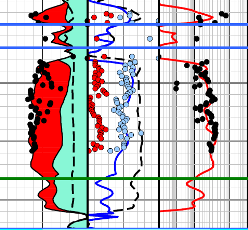
Bakken “Tight Oil” example showing core porosity (black dots), core oil saturation (red dots). core water saturation (blue dots), and permeability (red dots). Note excellent agreement between log analysis and core data. Separation between red dots and blue water saturation curve indicates significant moveable oil, even though water saturation is relatively high (see text below for explanation).

“Tight Oil” as a descriptive term covers a wide variety of reservoir conditions. For example, the Nordegg in many places in Alberta is quite porous and would be permeable if it were not partially or completely plugged with pyrobitumen. The shaly parts are often described as bituminous shale. Mineralogy varies from near pure quartz to dolomite to calcite, with all shades of grey in between. Classical crossplots to find TOC are meaningless due to these mineral variations.

Impossibly low water saturation on log analysis (equivalent to very high resistivity) is the clue to the pyrobitumen. Core porosity and saturation is also a clue, since pyrobitumen is not soluble in normal solvents, so the core cannot be “cleaned”.


Example of a well in the Nordegg “tight oil” play. This well is “tight” because of pyrobitumen. Core porosity (black dots) is equivalent to water filled porosity, core oil saturation is very high (red dots in saturation track, core water saturation is very low (blue doys) as is computed water saturation. “Pay Flag” is black to indicate pyrobitumen, instead of red that would indicate mobile fluids.


BAKKEN GEOLOGY
Oil in the Bakken in southeastern Saskatchewan has migrated from mature Bakken source rocks in North Dakota and Montana. The best reservoir is associated with the Upper Middle Bakken Sandstone Facies (BF4).  Average porosity ranges from 14% to 16% and permeabilities are 20 to 80 millidarcies. The unconventional siltstone reservoir (BF2) averages 9% to 12% porosity and 0.01 to 1.0 millidarcies. In the deeper North Dakota wells, porosity is somewhat lower but permeability may be higher. All facies types have been exploited in different parts of the Basin.

These facies were deposited during the late Devonian and early Mississippian in what was then a tropical setting. The sediment is believed to have an aeolian source and was blown into the marine environment from the adjacent arid landmass to the east and reworked into the various marine facies. The organic rich Upper and Lower Bakken shales are the source rocks for the sand and silt reservoirs.

The sands and silts are highly dolomitic, averaging about 50% dolomite. In deeper wells, calcite may replace some of the dolomite or infill some porosity.

Many of the dominant features of the Bakken are below the resolution of logging tools and are best seen in core photos and core logs, as shown below. 


Core photo of Middle Bakken burrowed siltstone

 
Core photo of Middle Bakken laminated fine grained sandstone


While laminated shaly sands are best known, laminated porosity is also a problem for log analysts. The Bakken and Montney reservoirs in Canada are good examples. The illustrations below give a clear example of how porosity logs and analysis results smooth out the porosity variations, which in turn smooth out the saturation and permeability answers. The latter is especially critical, since productivity estimates for laminated reservoirs can be seriously under-estimated because the high permeability streaks tend to be ignored.


Core description log in a laminated Bakken sand. Upper half of interval is highly laminated, lower half has thicker beds. See plot of core data below. (Illustration courtesy Graham Davies Geological Consultanting)


Closely spaced core samples demonstrate laminated nature of Bakken sand, compared to the running average created by well logs. Distinct coarsening upward and fining upward sequences can be seen in the upper half of core (grid lines are 1 meter). The lower half of the cored interval is less laminated, so porosity and permeability variations are smaller. Longer running average on resistivity log makes water saturation even more difficult to assess and comparison to core is worse than for porosity and permeability
  Logs and core are for same well as core description shown above.

In Saskatchewan, the naturally low resistivity in Bakken pay zones is further aggravated by thin clay laminations, clay filled burrows, laminated porosity, and dispersed pyrite.

Even more confusing is the water resistivity variation on the northwest and northeast edges of the Basin. Here, wet wells have higher resistivity than oil wells further south because the water resistivity is 5 to 20 times higher than deeper in the Basin. This results from fresher water recharge from the Black Hills of North Dakota. An adequate production testing program is the only solution to this issue, as there is no log analysis model that will predict water resistivity in this reservoir.

Water salinity in the deeper North Dakota wells reaches 325,000 ppm, making for exceedingly low water resistivity. In Saskatchewan, salinity is usually at 200,000 ppm or more, but can be as low as 25,000 in the recharge area. Pore geometry in the deeper parts is more intergranular in texture and irreducible water saturation is lower than in Saskatchewan.

Typical SW in Saskatchewan averages 50% grading southward to about 30% in the deeper North Dakota wells. Very low apparent SW in Saskatchewan usually means fresh water recharge, possibly with some residual oil. The "best-looking" wells are actually water producers, but have measured resistivity values 2 to 4 times higher than productive oil wells. Water resistivity values are sparse, so any water recovery should be sent to the lab and analyzed.

The low resistivity, high radioactivity, large density neutron separation caused by dolomite and pyrite, and the high PE value (near 3) conspire to make the zone look like shale on logs. Worse, some literature continues to name the producing zone the Bakken Shale, even though we know the Middle Bakken is a radioactive dolomitic sand or siltstone. These conflicts in the conventional data suggest strongly that some special core analysis should be done, namely electrical properties, capillary pressure, X-Ray diffraction and thin section mineralogy, and anything else that can help explain the petrophysical response to these complex rocks.

The Bakken is now the biggest oil play in North America, and may ultimately be the largest ever found, even larger than Alaska North Slope. It is sometimes termed an "unconventional" reservoir, due to the low permeability of the siltstone intervals. In North Dakota, it is also called a "resource" play because the oil was formed in place (from the Upper and Lower Bakken Shales), although in Saskatchewan the oil migrated from the deeper parts of the basin, and is not strictly speaking a resource play there. Alberta and Montana is also probably a resource play, but few facts have been published so it is hard to tell.

Vertical wells are not overly prolific due to the low intrinsic permeability of the silty sand, but most horizontal wells do OK. In the deep, hot, over-pressured region in North Dakota, some wells are flowing 1000 to 2000 barrels per day.

Core analysis techniques, in particular the sampling interval, are important in assessing tight oil or gas. Many, like the Bakken and Montney plays, show a laminated porosity sequence. It is easy to pick only the best sands, or  otherwise obtain unrepresentative samples. Since permeability is an exponential function of porosity (as a general rule), small  porosity variations make a big difference in productivity estimates. The detail matters, and since logs average about 1 meter of rock, log analysis permeability is often pessimistic, even though the average porosity is correct. At the right is the core and sonic log data for a Bakken well, showing that the log cannot track the fine detail seen in the core. Many core analyses take far fewer samples, so the laminated nature of the reservoir is masked by too coarse a sample interval.


BAKKEN SHALE VOLUME CALCULATIONS
The Bakken is radioactive due mainly to uranium that migrated with the oil. This can be identified with a spectral gamma ray log and it should always be run when penetrating radioactive sands. Sadly, it is often not requested, even though the service is cheap and costs no extra rig time.

Spectral gamma ray log shows Uranium (U), Potassium (K), Thorium (Th), and standard gamma ray (GR). Red vertical line is TH0, the clean line for the Thorium curve, and the black vertical line is GR0, the clean line for the GR curve. Bakken 8 is top of sand and Bakken 1B is base of sand. ==>

The Thorium curve is best for shale volume calculations. The SP is flat and useless, Density neutron separation is mostly due to dolomite so it cannot be used. The gamma ray can be used in the absence of the Thorium curve by assuming Uranium content is constant.
      1: VSHth = (TH - TH0) / (TH100 - TH0)
      2: VSHgr = (GR - GR0) / (GR100 - GR0)

The Clavier correction to the gamma ray result is often used to smooth out minor variations in uranium content that make the gamma ray look "noisy":
         3: VSHclavier = 1.7 - (3.38 - (VSHgr + 0.7) ^ 2) ^ 0.5

Choose VSHth in preference to VSHgr or VSHclavier when the thorium curve is available. This becomes Vsh for all future calculations.

The clean lines TH0 and GR0 are easy to pick (red and black lines on the illustration). Shale lines are harder as they are often off-scale to the right or buried under a plethora of backup curves. In the absence of a good pick from the log,  use:
      4: TH100 = TH0 + 25
      5: GR100 = GR0 + 150

Adjust the constants to suit your local knowledge.

BAKKEN POROSITY CALCULATIONS
Even though the Bakken is a complex mixture of quartz, dolomite, calcite, and sometimes pyrite, with a little clay, the standard density neutron complex lithology crossplot model works well:
      6: PHIdc = PHID – (Vsh * PHIDSH)
      7: PHInc = PHIN – (Vsh * PHINSH)
      8: PHIe = (PHInc + PHIdc) / 2

For porosity values greater than 0.05 fractional, this is an adequate representation of the crossplot; some software packages will use more complicated math to fuss with that third decimal place.

Equation 7 is equivalent to Crain's Rule #1: "Porosity is halfway between the density and neutron curves in clean zones" regardless of mineralogy, provided logs are on compatible porosity scales.


BAKKEN WATER SATURATION CALCULATIONS
Since there is little clay, the Archie model can be used, although it costs nothing extra to use a shale corrected saturation equation such as Simandoux or Dual Water:       12: IF PHIe > 0.0
      9: THEN C = (1 - Vsh) * A * (RW@FT) / (PHIe ^ M)
      10: D = C * Vsh / (2 * RSH)
      11: E = C / RESD
      12: Sws = ((D ^ 2 + E) ^ 0.5 - D) ^ (2 / N)
      13: OTHERWISE Sws = 1.0

Electrical properties variations between facies and with depth or diagenesis are not published. This lab work is worth the effort, as considerable increases in oil in place are possible with small reductions in M and N values. Fresh water recharge in the north can confuse log analysis results, so a production test is essential before drilling any horizontal wells.


BAKKEN PERMEABILITY CALCULATIONS
There is no strong correlation between porosity and permeability has been seen. The illustrations below show the scatter is large. The Wyllie Rose equation gives rational values and can be tuned to fit smoothed core data:
      8: Kmax = 100 000 * (PHIe^6) / (SWir^2)


Permeability versus porosity scatter plots for North Dakota well (left) and Saskatchewan well (right). The scatter suggests microfractures.
 

BAKKEN Lithology CALCULATIONS
How do we know which minerals to use in the petrophysical log analysis? Detailed sample descriptions are a good start. Both X-Ray diffraction data and thin section point counts can be used. Both methods are considered semi-quantitative and come from tiny samples compared to the volume measured by logs. So we don't get too excited about obtaining a close numerical match .

Mineral and core analysis summary for a Bakken reservoir ==>

Standard 3-mineral models using PE, density, and neutron data are used with appropriate parameters for the selected minerals. Multi-mineral solvers can be used if spectral gamma ray data is available. In this case, shale volume would be derived also.

PYRITE CORRECTIONS
Pyrite is a conductive metallic mineral that may occur in many different sedimentary rocks. It can reduce measured resistivity, thus increasing apparent water saturation. The conductive metallic current path is in parallel with the ionic water conductive path. As a result, a correction to the measured resistivity can be made by solving the parallel resistivity circuit.

Although the math is simple, the parameters needed are not well known. The two critical elements are the volume of pyrite and the effective resistivity of pyrite. Pyrite volume can be found from a two or three mineral model, calibrated by thin section point counts or X-ray diffraction data.

The resistivity of pyrite varies with the frequency of the logging tool measurement system. Laterologs measure resistivity at less than 100 Hz, induction logs at 20 KHz, and LWD tools at 2 MHz. Higher frequency tools record lower resistivity than low frequency tools for the same concentration of pyrite. The variation in resistivity is caused by the fact that pyrite is a semiconductor, not a metallic conductor. It is nature's original transistor, and formed the main sensing component in early radios.

Typical resistivity of pyrite is in the range of 0.1 to 1.0 ohm-m; 0.5 ohm-m seems to work reasonably well. The effect of pyrite is most noticeable when RW is moderately high and less noticeable when RW is very low.

The math is easiest when conductivity is used instead of resistivity:
     14: CONDpyr = 1000 / RESpyr    
     15: CONDcorr = 1000 / RESD - CONDpyr * Vpyr
     16: RESDcorr = 1000 / CONDcorr

The corrected resistivity can be plotted versus depth, along  with the original log. Corrected water saturation will always be lower or equal to the original Sw. If CONDcorr goes negative, lower Vpyr or raise RESpyr


RESERVOIR QUALITY FROM CAP PRESSURE
A capillary pressure (Pc) data set, along with some calculated parameters, is summarized in the table below.
 

CAPILLARY PRESSURE SUMMARY

Sample

Depth

Perm

PHIe

SWir

SWir

PHI*SW

PHI*SW

sqrt/PHIe)

Pore Throat


m

mD


425m

100m

425m

100m


Radius um

Bakken


1

03.5

2.40

0.118

0.12

0.19

0.014

0.022

4.51

1.358

2

04.3

0.24

0.137

0.62

0.94

0.085

0.129

1.32

0.036

3

04.5

0.32

0.139

0.39

0.64

0.054

0.089

1.52

0.100

4

05.2

0.77

0.149

0.31

0.62

0.046

0.092

2.27

0.113

Average

04.4

0.93

0.136

0.36

0.60

0.050

0.083

2.41

0.402


Torquay


5

16.8

0.05

0.163

1.00

1.00

0.163

0.163

0.55

0.008

6

20.4

0.07

0.145

0.59

0.97

0.086

0.141

0.69

0.038

7

21.8

0.09

0.174

0.79

0.96

0.137

0.167

0.72

0.019

8

23.8

0.03

0.157

1.00

1.00

0.157

0.157

0.44

0.009

9

31.4

0.07

0.138

0.83

0.98

0.115

0.135

0.71

0.017

Average

24.4

0.07

0.154

0.80

0.98

0.124

0.150

0.64

0.021

In higher permeability rock, the cap pressure curve quickly reaches an asymptote and the minimum saturation usually represents the actual water saturation in an undepleted hydrocarbon reservoir above the transition zone. In tight rock, the asymptote is seldom reached, so we pick saturation values from the cap pressure curves at two heights (or equivalent) Pc values) to represent two extremes of  reservoir condition.

Only sample 1 in the above table behaves close to asymptotically, as in curve A in the schematic illustration at the right. All other samples behave like curves B and C (or worse). The real cap pressure curves for samples 1 and 2 are shown below.


Examples of capillary pressure curves in good quality rock (sample 1 – left) and poorer quality rock
(sample 2 – right)

The summary table shows wetting phase saturation selected by observation of  the cap pressure graphs at two different heights above free water, namely 100 meters and 425 meters in this example. In this case, the 100 meter data gives water saturations that we commonly see in petrophysical analysis of well logs in hydrocarbon bearing Bakken reservoirs in Saskatchewan. This is a pragmatic way to indicate the water saturation to be expected when a Bakken reservoir is at or near irreducible water saturation. The data for the 450 meter case is considerably lower and probably does not represent reservoir conditions in this region of the Williston Basin.

Two other columns in the table are calculated from the primary measurements.

The first is the product of porosity times saturation, PHI*SW, often called Buckle’s Number. It is considered to be a measure of pore geometry or grain size. Higher values are finer grained rocks. These values vary considerably in the Bakken, between low and medium values, indicating the laminated nature of the silt / sand reservoir. The values in the Torquay are uniformly high, indicating that the reservoir is poor quality in all samples.

The second is the square root of permeability divided by porosity, sqrt(Kmax/PHIe), which is another measure of reservoir quality, directly proportional to pore throat radius and Pc. High numbers represent good connectivity and low values show poor connectivity. Again, the Bakken shows the variations due to laminations, and the Torquay shows low values and unattractive reservoir quality.

 
Examples of pore throat radius distribution in good quality rock (sample 1 – left) and poorer quality rock (sample 2 – right)

By comparing cap pressure and pore throat distribution graphs from each sample with the quality indicator values in the summary table, it becomes more evident as to which parameters in a petrophysical analysis might be the best indicator of reservoir quality. Since both Buckle’s Number and the Kmax/PHIe parameter can be determined from logs, it has been relatively common to assess reservoir quality from these parameters as a proxy for capillary pressure and pore throat measurements.

However, in thinly laminated reservoirs like the Bakken, this is not always possible since the logging tools average 1 meter of rock. This means we cannot see the internal variations of rock quality evident in the core data.
 

BAKKEN EXAMPLES


Resistivity log on low resistivity, radioactive Bakken sand (4 ohm-m in best sand). Note high resistivity upper and lower shales, which are the source rock for the oil in the sand. These are "real" shales with gamma ray readings between 250 and 500 API units. Spectral GR shows low but significant uranium content in sand and very high uranium in the shales, associated with the kerogen content. The thorium curve is the best clay indicator.


Density neutron logs on low resistivity, radioactive, dolomitic Bakken sand. Note high apparent porosity (almost coal values) in upper and lower shales. Density neutron separation and PE show a 50-50 mix of quartz and dolomite with a few percent pyrite. XRD and sample descriptions confirm this analysis.


The sonic log is also useful in a 3 or 4 mineral model and for calculating porosity in older wells that have no density neutron logs. Matrix travel time needs to be calibrated to allow a match to core.


The answer plot illustrates the mineral mix and the good match to core porosity and permeability that was achieved. The curves in the correlation track are, from left to right, uranium, potassium, thorium, total gamma ray.


Here is a different well with the pyrite correction applied to the resistivity log. The before and after
versions of the resistivity are shown in Track 2, along with the pyrite fraction determined from a
3-mineral model using PE-density-neutron logs. The correction raises the resistivity about 0.5
ohm-m and reduces water saturation by about 10%. Making the pyrite more conductive would
raise RESD further, but as yet no one has provided any public capillary pressure data in this area
to calibrate SW. The SWir from an NMR log would also help calibrate this problem.
 

Copyright © E. R. (Ross) Crain, P.Eng.  email
Read the Fine Print