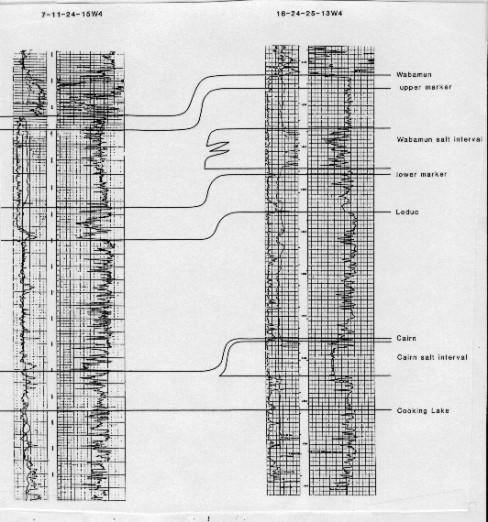
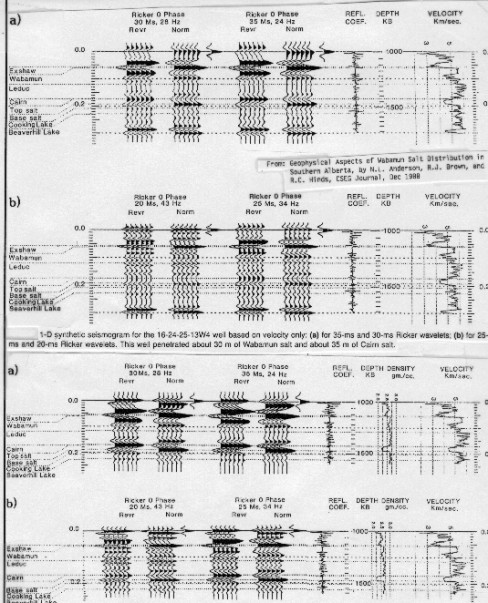
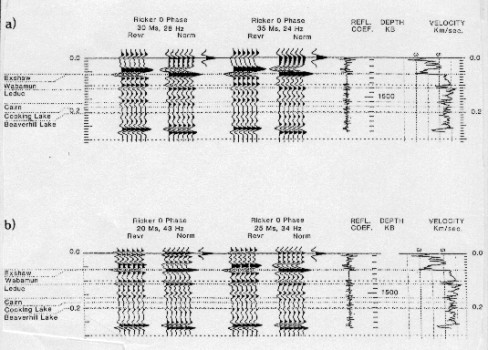
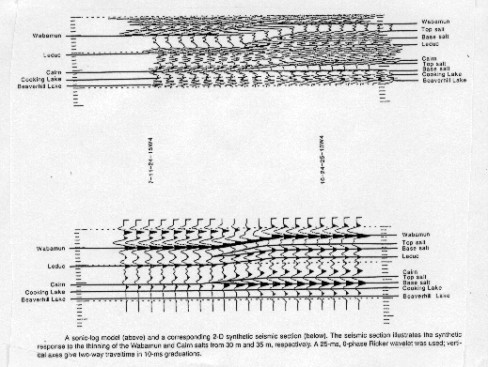
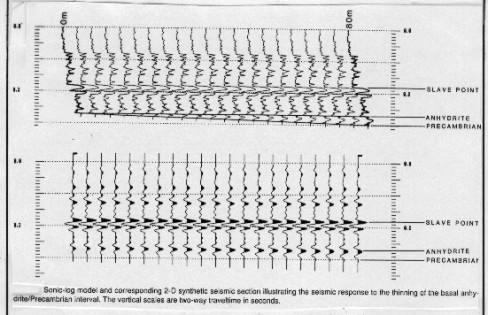
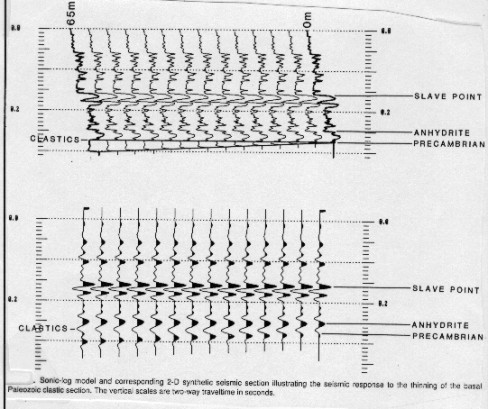
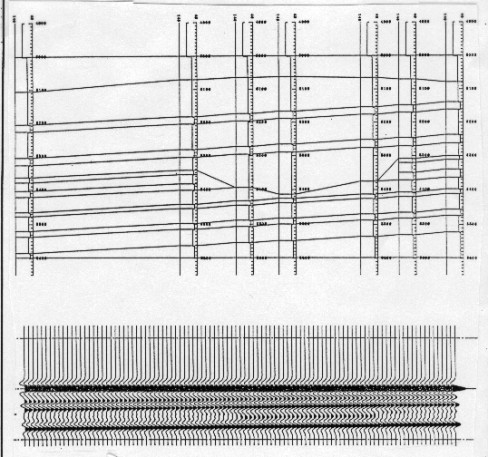
The synthetic (top) shows a model with two salt layers based on sonic data only. Adding the density data increases the amplitude of the reflections. Comparison of the models make it relatively easy to itemize the characteristics of salt and salt free cases. Notice that the wavelet frequency is critical to identification of the formation tops.
The model below portrays a synthetic seismic section based on interpolation of the sonic logs between the salt and salt free cases. The model would be improved by use of density data augmenting the sonic.
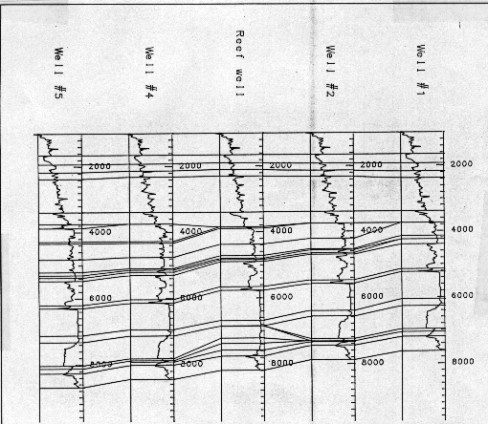
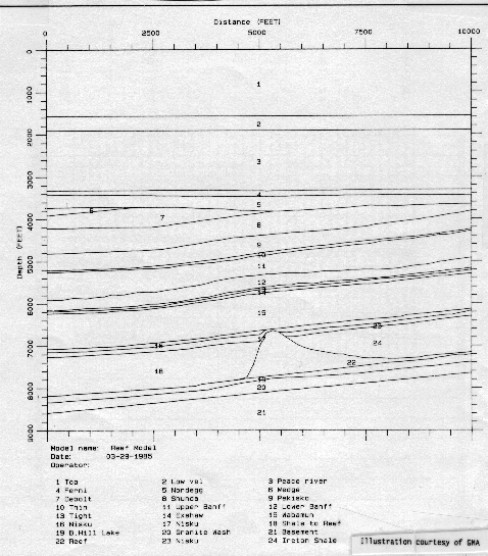
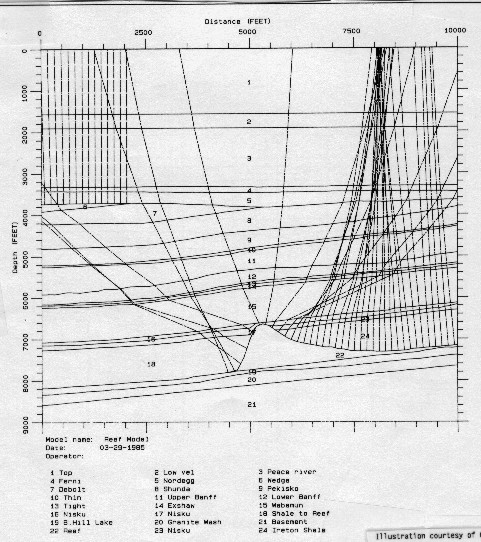
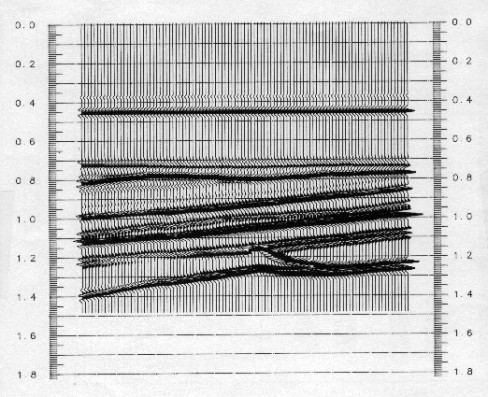
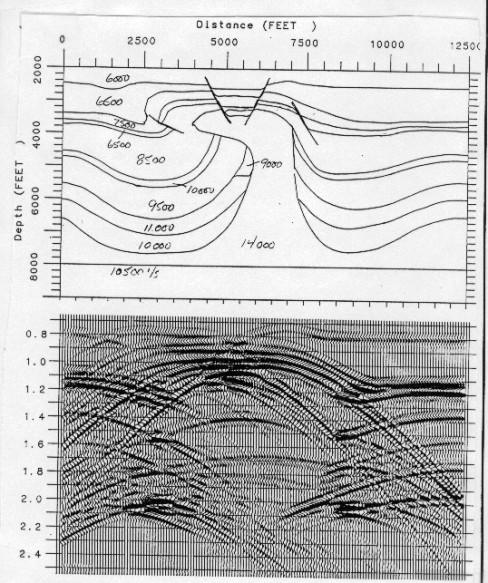
In this example, the reef was edited to a geologically believable shape. The acoustic impedance cross section is then computed and displayed. This cross section uses raw sonic log data that has been interpolated between well control. The sonic logs may need editing for bad hole, casing, rock alteration, or gas effects. If gas or carbonates are present, the model should incorporate density information as well.
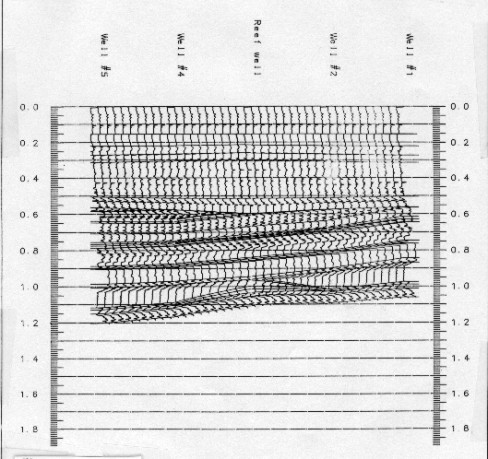
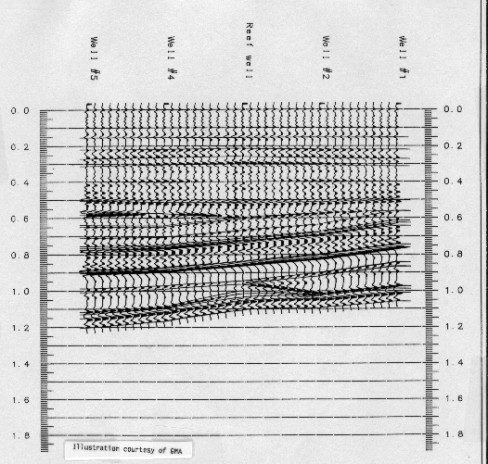
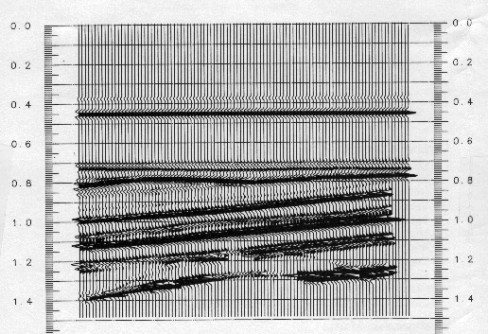
A synthetic seismic section is calculated by creating reflection coefficients from impedance and convolving a wavelet with each modeled trace.
This is the usual form of synthetic modeling, but this example used logs which received no editing or correction for invasion. If the reef contained gas or had higher porosity than the platform rock, the synthetic section would be wrong because the modeled velocity and density would be wrong. Thus a number of different formation models could be created. The seismic response of the models can be compared to each other and to field data using discriminant analysis or frequency analysis techniques or, more commonly, by visual inspection. If sufficient discrimination between various models can be detected, then the comparison of these models with field data should provide a valuable interpretation aid. Another form of modeling is ray path tracing, a time consuming computer solution. The ray paths to each key horizon are computed from the laws of refraction, and a synthetic section is prepared using the noise free reflection coefficients at each layer modeled. Both normal (perpendicular) and vertical incidence sections are displayed in this example. These are used to judge the quality of the reflections to be expected from the steeply dipping beds.
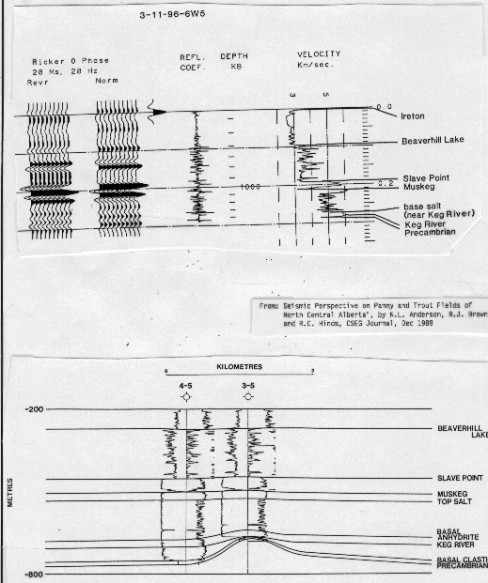
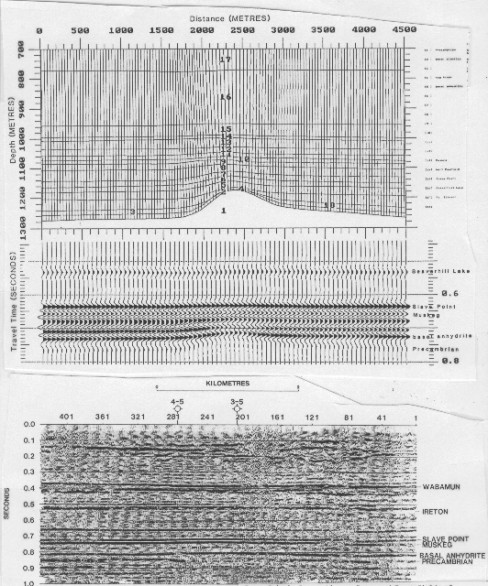
A typical synthetic seismogram is given below as well as a geologic cross section from logs. The seismic model, synthetic section, and real seismic section follows. The basement high and surrounding basal sand are the key elements in this model. Note that there is no significant reflection from the bald high because the evaporites above mask the event. The model would be more realistic if density data were incorporated.
Stratigraphic traps, such as channels, beaches, and bars can also be modeled by using adequately modeled log data.
|
|
||
|
Page Views ---- Since 01 Jan 2015
Copyright 2023 by Accessible Petrophysics Ltd. CPH Logo, "CPH", "CPH Gold Member", "CPH Platinum Member", "Crain's Rules", "Meta/Log", "Computer-Ready-Math", "Petro/Fusion Scripts" are Trademarks of the Author |
|||


|
||
| Site Navigation | SEISMIC PETROPHYSICS CASE HISTORIES SYNTHETIC SEISMOGRAMS | Quick Links |
 Case Histories: Synthetic Seismograms